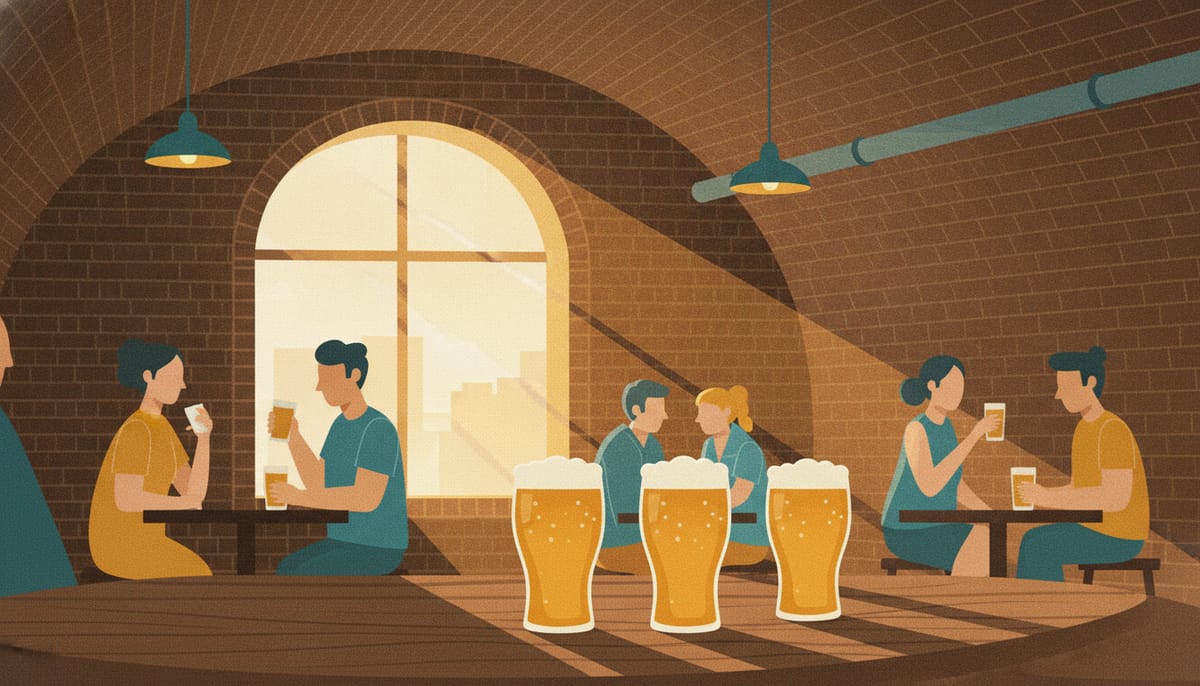
"Session beer" and "session IPA" turn up on a lot of taproom boards, and we get asked what the term actually means most weekends we're out on the Bermondsey Beer Mile. It's a genuinely useful category once you know what you're looking at: a beer built to be drunk more than once in an afternoon without the alcohol catching up with you. Here's what makes a beer "sessionable", how session IPAs fit in, and why we see a lot of guests leaning on them across a six-taproom day.
The short answer
A session beer is a lower-strength beer — roughly 3% to 4.5% ABV — brewed to keep real flavour and character despite the reduced alcohol, so you can have more than one over the course of a "session" without it derailing the rest of your day. A session IPA applies that same idea to India Pale Ale: full hop aroma and flavour, but at a strength closer to a standard lager than a full-fat West Coast IPA. Neither term is a legally protected style, so you'll see some variation in exactly where brewers draw the ABV line, but the drinking logic behind both is consistent.
Where the idea comes from
The word "session" has been used in British pub culture for decades to describe a stretch of drinking over an afternoon or evening — several pints, unhurried, usually social. A "session beer" is simply one built to survive that: strong enough to taste like something, weak enough that the third or fourth pint doesn't wreck your evening. English bitters and milds were arguably the original session beers long before the term caught on in craft brewing, often sitting in the 3.5–4.2% range for exactly this reason — a Victorian brewery arch worker or a docker knocking off a shift wasn't looking to be knocked sideways by lunchtime, just to have something drinkable with company. Craft brewers picked the label up more explicitly over the last fifteen years or so, partly as a reaction to the escalating strength of early American craft beer, where bigger and hoppier had become the default, and "session" versions of big styles became a deliberate corrective across cask ale, keg lines and canned beer alike.
What ABV actually counts as "session"
There's no single official cut-off, but most UK brewers and drinkers put session beer somewhere between about 3% and 4.5% ABV, with some purists insisting on 4% as the ceiling. Push much past 4.5%, into the 5–5.5% range typical of a standard lager or pale ale, and it's generally just called a regular-strength beer rather than a session beer, even if it happens to be very drinkable. If you want the actual maths behind ABV and how it translates into units in your glass, our units in a pint of beer guide breaks that down properly — it's worth a read if you're trying to pace a day out sensibly.
Session IPA: the hoppy exception
The India Pale Ale style has drifted upward in strength since its craft revival, with West Coast IPAs commonly landing around 6–7% and double or imperial IPAs pushing well past that. A session IPA is the deliberate correction: brewed to around 3.5–4.5% ABV, using a lighter malt bill so there's less sugar for the yeast to convert into alcohol, while still loading the beer with the same late-hop and dry-hop additions that give a full-strength IPA its citrus, pine or tropical-fruit character. It's a genuinely tricky beer to brew well — strip out too much malt body and the beer can taste thin or watery next to the hop punch, which is why session IPA quality varies more between breweries than you might expect. Our what does IPA stand for guide covers the wider IPA family, from West Coast through NEIPA, if you want the full picture before narrowing in on the session end of it.
Session beer vs low ABV vs alcohol-free
It's worth keeping three categories straight, because they get lumped together fairly often. Session beer, at roughly 3–4.5% ABV, is still a normal alcoholic beer, just a lighter one. "Low alcohol" beer usually sits under about 1.2% ABV under UK rules, and alcohol-free beer is capped at 0.05% ABV — both are a different product entirely, brewed or processed specifically to remove most or all of the alcohol rather than simply using less malt. If your interest in session beer is really about drinking less, session-strength beer is a reasonable middle ground, and a lower-ABV pour will also generally carry fewer calories than its full-strength equivalent — see our calories in a pint of beer guide for the numbers by style and strength.
Why sessions suit a day of tasting
This is the bit that comes up most on our own tours. A day spent tasting at several breweries is a very different drinking pattern from settling into one pub with one pint — you're having a smaller pour at each stop, moving around, talking to brewers and other guests, and doing it for hours rather than one sitting. Session-strength beers and session IPAs make that far easier to pace sensibly, because the cumulative alcohol across five or six stops adds up a lot more slowly than it would with full-strength pours throughout. On our Bermondsey Beer Tasting Tour — 2–3.5 hours, £49pp, four independent taprooms, beer included at every stop, meeting at Southwark Brewing Co, 46 Druid St — we regularly see guests deliberately picking the lower-ABV beer on a taproom's board partway through the afternoon, precisely so they're still in good form for the last stop. It's a small, practical bit of pacing that works whether you're joining a public date or booking one of our private tours for a group of 6 up to 60+, and it's just as useful advice for a work social as it is for a stag or hen weekend, where staying on your feet for the whole afternoon actually matters.
How to spot a session beer on a taproom board
- Check the ABV first — most London taprooms list it clearly next to each beer, and anything around 3–4.5% is worth trying if you're pacing yourself.
- Look for the word "session" in the beer's name or description, which brewers increasingly use as shorthand for exactly this category.
- Don't assume light in colour means light in strength — a session IPA can be as pale and hazy as a full-strength one, so the colour tells you nothing about the ABV.
- Ask the bar staff which beer on the board they'd recommend if you want flavour without a heavy pour — most independent taprooms know their range well.
- Pace across the day, not just the beer — mixing a couple of session pours in among stronger ones is a perfectly normal way to get through a longer tasting session.
Related reading
If you're new to beer styles generally, our lager vs ale guide is a good starting point, and our how is beer made explainer covers where ABV actually comes from in the brewing process. For a wider look at what separates true craft beer from the mainstream, see what is craft beer.
Make a full day of it
Pair a tasting afternoon with our free self-guided heritage walk through Southwark's brewing history, or pick up a gift voucher for someone who'd appreciate a proper introduction to session beer — delivered instantly by email and never expire, so they can choose their own date.