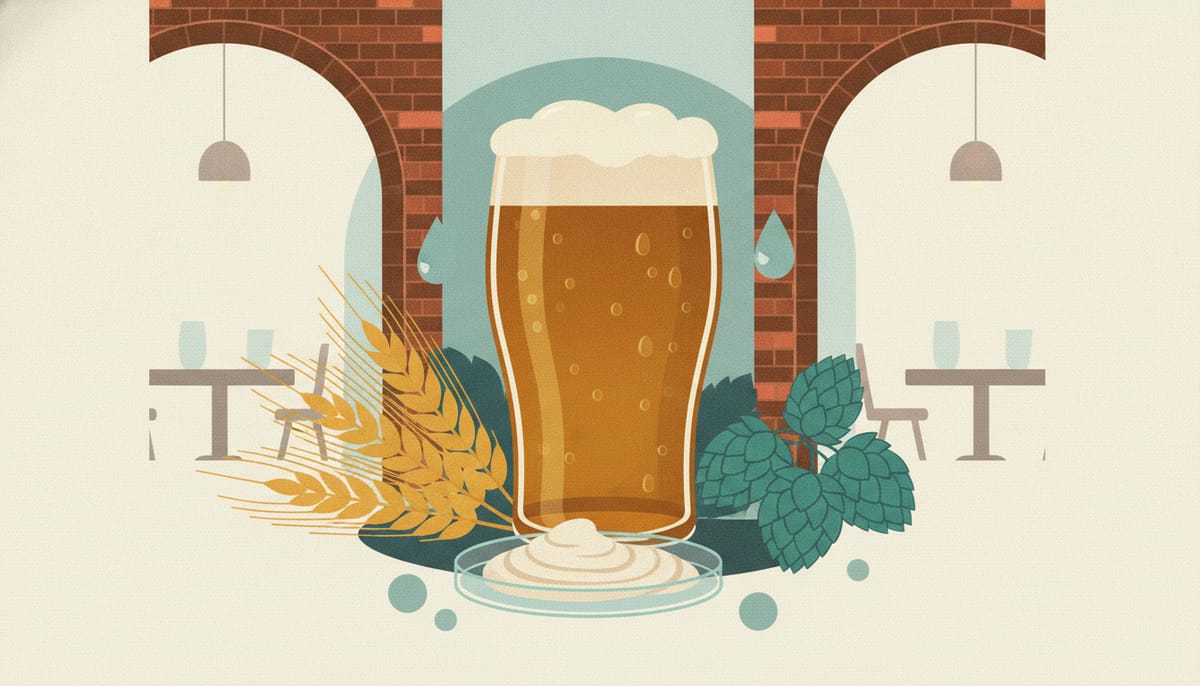
"How many calories is that going to cost me?" is a question we hear almost as often as "how many units is this pint?" on our guided tours — usually asked half-jokingly somewhere around taproom two. The honest answer, just like with units, is that it depends heavily on strength and style, and there's a wider range than most people expect. Here's the maths in plain English, a quick-reference table for common strengths, where those calories actually come from, and how we think about balance — not guilt — on a day of tasting across the Bermondsey Beer Mile.
The quick answer
As a rough guide, a standard UK pint (568ml) of 4% lager is around 180 calories. Push the ABV up and the calorie count climbs with it: a 5% craft lager or pale ale is closer to 210, a 6% IPA sits around 250, and an 8%+ double IPA or imperial stout can run to 330–400 calories or more in a single glass. These figures are indicative rather than exact — brewers don't have to print calorie counts on cans and kegs the way food packaging does, so treat this as a sensible planning guide rather than a lab result, and check a specific brewery's own nutritional information if you want precision.
Where beer's calories actually come from
Two sources: alcohol and residual carbohydrate. Pure alcohol provides about 7 calories per gram — nearly as calorie-dense as fat — and because a beer's alcohol content scales directly with its ABV, alcohol is the single biggest driver of calorie count. The second source is residual carbohydrate: the unfermented sugars and starches left over from brewing that give beer its body and mouthfeel. This varies more by recipe than by strength alone, which is why two beers at the same ABV can still have noticeably different calorie counts — a drier, more fully fermented beer typically has less residual sugar than a sweeter, fuller-bodied one.
Calories in a pint, by strength: quick-reference table
Here's an indicative breakdown across the strengths you'll actually meet on a taproom crawl, from a session beer to a big imperial stout.
| Beer style (typical ABV) | Calories in a pint (568ml) |
|---|---|
| Session pale / session IPA (3.5%) | ≈ 160 kcal |
| Standard lager (4%) | ≈ 180 kcal |
| Cask ale / bitter (4.2%) | ≈ 185 kcal |
| Craft lager / pale ale (4.5–5%) | ≈ 200–210 kcal |
| Standard IPA (5.5–6%) | ≈ 235–250 kcal |
| Double / imperial IPA (7.5–8.5%) | ≈ 310–350 kcal |
| Imperial stout (9%+) | 380+ kcal |
Notice the same pattern as with alcohol units: a pint of a 9% imperial stout can carry well over double the calories of a session pale ale, even though it's exactly the same size glass. That's worth bearing in mind if you're sampling several different styles across an afternoon — which is exactly what happens on our guided Beer Mile tour, and it's part of why understanding units in a pint of beer and calories go hand in hand.
How beer compares to other drinks
It's a common assumption that beer is uniquely calorific compared with wine or spirits, but that's not really true once you match for alcohol content. A standard 175ml glass of wine (12% ABV) is typically cited at around 160 calories, and a 25ml spirit measure (40% ABV) at around 60 calories before you add a calorie-carrying mixer — broadly comparable, gram for gram of alcohol, to a pint of beer. The real difference is volume: you're typically drinking far more liquid in a pint of beer than in a glass of wine or a spirit measure, which is part of why beer has a reputation as more filling. As with any third-party nutritional figures, treat exact numbers for other drinks as approximate and check the specific product if it matters to you.
Why craft beer often runs higher
A generation ago, "a pint" reliably meant something around 3.5–4.2% ABV and a fairly predictable calorie count. Modern craft brewing has widened that range considerably: hazy IPAs, double IPAs and barrel-aged stouts routinely sit at 6–9% ABV or beyond, and richer styles like pastry stouts are often brewed with additional sugars, lactose or fruit purée for flavour — all of which add calories on top of the alcohol. That's a fair trade for the flavour and variety on offer, but it does mean the old mental shortcut of "a pint is about 180 calories" is increasingly wrong for a lot of what's actually on tap in London's taprooms. If you want to understand where that extra body and sweetness comes from during the brew, our guide to how beer is made covers the fermentation process in plain English, and our piece on lager vs ale explains how yeast and temperature shape the style you end up drinking.
Lower-calorie ways to still taste widely
You don't have to give up variety to manage your calorie count on a tasting day. A few practical approaches:
- Order thirds or halves. Most London taprooms, including all six on our tour, pour in two-thirds (379ml) and halves (284ml) as well as full pints — a two-thirds of a 6% IPA works out to roughly the same calories as a half pint of it, letting you try more without the running total climbing as fast.
- Check the ABV before you order. It's the single biggest lever on calorie count, and UK breweries are required to display it on the pump clip or can.
- Lean toward session styles. A session pale or classic cask bitter at 3.5–4.2% will reliably run lower than a hazy double IPA, whatever the can art suggests.
- Consider alcohol-free or low-alcohol options. Since most of a beer's calories come from alcohol itself, a 0.5% beer is typically a fraction of the calories of its full-strength equivalent.
- Don't skip food to "save" calories. Drinking on an empty stomach makes for a worse day out and doesn't meaningfully change the maths — eat properly before and during.
What matters more than any single number is the overall balance of your week and how you feel on the day — the same "moderation, not restriction" approach we'd suggest for counting units applies here too.
How we think about it on a tasting day
Our guided Beer Mile Tour (£49pp, 2–3.5 hours, tastings included) visits four independent taprooms across an afternoon, and we've been running it since 2014, so pacing — calories and units both — comes up constantly with guests. We're not precious about it: the point of the day is to taste widely and have a properly good time, not to hit a number. If you'd rather build in a lighter, largely beer-free stretch, our free self-guided heritage walk around Southwark's brewing history is a great add-on, and our Saturday cheese, meat & beer tour is a smaller, seated tasting rather than pint-for-pint drinking.
Planning a group day out?
If you're organising for a group — a birthday, a work social or a stag or hen do — it's worth knowing that a guided crawl naturally paces the drinking for everyone, rather than letting rounds and peer pace push people through pints faster than they'd choose alone. It's one of several reasons a guided day tends to be more enjoyable, calorie-conscious or not, than an unguided one. For more on planning it yourself, see our roundup of London pub crawl routes, and if you're new to the scene our explainer on what actually counts as craft beer is a good primer before you go.
A gift that comes with the maths already worked out
If you're buying for someone who enjoys their beer but likes to know what they're getting into, a guided tasting day takes the guesswork out of both units and calories — our guides talk through both without making anyone feel like they're being lectured. Gift vouchers are delivered instantly by email and never expire, so the recipient can pick a date that suits.