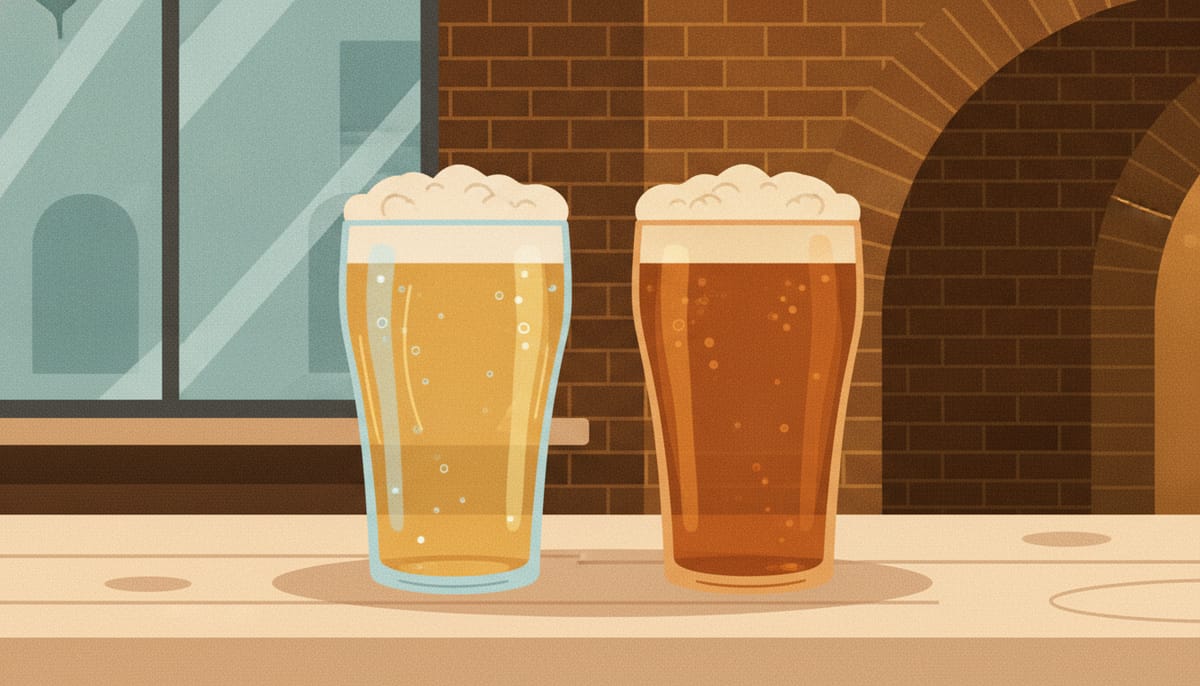
We get asked this most weeks on the Beer Mile: what actually makes a lager a lager, and an ale an ale? It's not the colour, and it's not really the strength — both families run from pale and light to dark and heavy. The real answer is yeast and temperature. Once that clicks, a lot of confusing beer labels suddenly make sense. Here's the difference in plain English, plus where to taste both styles side by side in London.
The short answer
Ale is brewed with top-fermenting yeast at warm temperatures (roughly 15–24°C), fermenting fast — often in a few days — and producing fruity, complex, sometimes spicy flavours. Lager is brewed with bottom-fermenting yeast at cold temperatures (roughly 7–13°C), fermenting slowly and then resting for weeks in near-freezing storage — "lager" comes from the German for "to store". That cold, slow process is what gives lager its clean, crisp, less fruity character.
Both are beer. Ale and lager are simply the two main branches of the beer family tree, and almost every style you've heard of — IPA, stout, pilsner, wheat beer — sits under one or the other.
Yeast: the real dividing line
The whole split comes down to which strain of yeast is doing the fermenting:
- Ale yeast (Saccharomyces cerevisiae) works at warmer temperatures and rises to the top of the fermenter — hence "top-fermenting". It's fast and produces esters, the compounds behind ale's fruity, sometimes banana- or pear-like notes.
- Lager yeast (Saccharomyces pastorianus) works at colder temperatures and settles at the bottom — "bottom-fermenting". It produces far fewer esters, which is why lager tastes cleaner and lets malt and hops speak more plainly.
This is also why homebrewers and small breweries often start with ales: ale yeast is more forgiving of temperature swings and ferments quicker, while proper lager needs consistent cold control and patience.
Temperature and time
Ale fermentation typically takes a matter of days at room-adjacent temperatures. Lager fermentation is colder and much slower, followed by a "lagering" period — weeks of cold conditioning that smooths out the flavour and gives lager its characteristic clarity and crispness. That extra time and cold storage is one reason traditionally lagered beer can cost more to produce than a quick-turnaround ale.
Common ale styles
- IPA — hop-forward, from crisp West Coast styles to hazy, juicy NEIPAs. See our guide to what IPA actually stands for.
- Pale ale — lighter and more balanced than an IPA, still noticeably hoppy.
- Stout and porter — dark, roasty ales; despite the colour, Guinness is an ale, not a lager, because it uses top-fermenting yeast.
- Wheat beer — light, often cloudy, with banana-and-clove character from the yeast.
- Bitter — the classic cask-conditioned English pub ale, malt-forward and low-fizz.
Common lager styles
- Pilsner — the original golden lager, crisp and noticeably hoppy for a lager style.
- Helles — a malt-forward, softer German lager.
- Mass-market lager — the pale, fizzy, easy-drinking lagers that dominate UK pub taps; brewed for consistency more than complexity.
- Dark lager (Dunkel, Schwarzbier) — proof that lager isn't always pale; the colour comes from the malt, not the yeast.
So why does "craft beer" often taste so different from lager?
Because a lot of what gets called craft beer is ale, not lager. Independent breweries lean heavily on ale styles — IPA especially — because ale yeast ferments faster (cheaper, quicker turnaround for a small brewery) and produces the bold, fruity, hop-forward flavours that craft drinkers tend to chase. Mass-market lager, by contrast, is engineered for a clean, consistent, crowd-pleasing profile. Neither approach is "better" — they're just aiming at different things. If you want to actually taste the difference rather than just read about it, that's exactly what a taproom crawl is for.
Strength isn't the deciding factor
A common myth is that lager is always weaker and ale always stronger, or vice versa. Not true — ABV depends on the individual beer and style, not the family. You'll find 3.5% session lagers and 3.5% session IPAs; you'll also find 9% imperial stouts and 9% strong lagers (doppelbocks, for instance). If you want a reliable read on strength, check the ABV on the can or the pump clip, not whether it's called a lager or an ale.
Taste both side by side in Bermondsey
The easiest way to actually understand the difference is to taste it. Our guided Bermondsey Beer Tasting Tour (£49pp, 2–3.5 hours, tastings included) takes you through four independent taprooms along the railway arches, where you'll usually find both crisp lagers and punchy ales on the same bar — a proper side-by-side comparison with a guide on hand to explain what you're drinking as you go. We've been running the tour since 2014, meeting at Southwark Brewing Co, 46 Druid St, and we host private groups from 6 up to 60+.
What to order if you're comparing the two
- Start with a pilsner or helles to get a clean lager baseline — you're looking for crispness and a light hop bite.
- Follow with a pale ale from the same brewery if it's on — the fruitier, rounder character should be obvious straight away.
- Try an IPA to see the ale family at its boldest; see our IPA explainer for the style breakdown.
- Finish on something dark — a stout or porter — to prove to yourself that colour has nothing to do with the lager/ale split.
Ask any of our guides on the day and they'll happily point you to the best lager-vs-ale flight at each stop — it's one of our favourite bits of the tour to talk through.
Serving temperature and glassware
The yeast difference carries through to how each is best served. Lager is traditionally poured cold — around 3–7°C — into a tall glass that shows off its clarity and holds a good head; that chill mutes some flavour, which is part of why lager reads as "refreshing" rather than complex. Ale is generally served warmer, anywhere from 8–13°C, letting more of those fruity esters and hop aromas come through. Cask-conditioned "real ale" goes further still, served at cellar temperature with natural carbonation from a live secondary fermentation in the cask rather than added CO2 — softer bubbles, rounder texture, and a flavour that changes subtly cask to cask. If a pint tastes flat compared with a keg lager, that's often the point rather than a fault.
A quick myth-check
- "Lager is always fizzier." Not necessarily — carbonation is a brewing choice, not a rule of the style.
- "Dark beer is always ale." Mostly true in practice, but dark lagers like Schwarzbier exist and prove colour comes from malt, not yeast family.
- "Craft beer means ale." Not by definition — plenty of independent breweries make excellent lagers too, though ale dominates the UK craft scene.
- "Real ale and ale are the same thing." Not quite — "real ale" specifically refers to cask-conditioned ale that undergoes a secondary fermentation in the cask, a further distinction within the ale family.
Make a full day of it
If beer styles have got you curious about how the whole process works, our how is beer made guide walks through mashing, boiling, fermenting and packaging — the bit that happens before yeast choice even comes into play. Pair a Beer Mile afternoon with our free self-guided heritage walk through Southwark's brewing history, or round it off with our Saturday cheese, meat & beer tour for a fuller sensory comparison of styles.
Gift the comparison
If you know someone who'd enjoy working this out glass in hand, our gift vouchers are delivered instantly by email and never expire, so they can pick their own date to come and taste the difference for themselves.