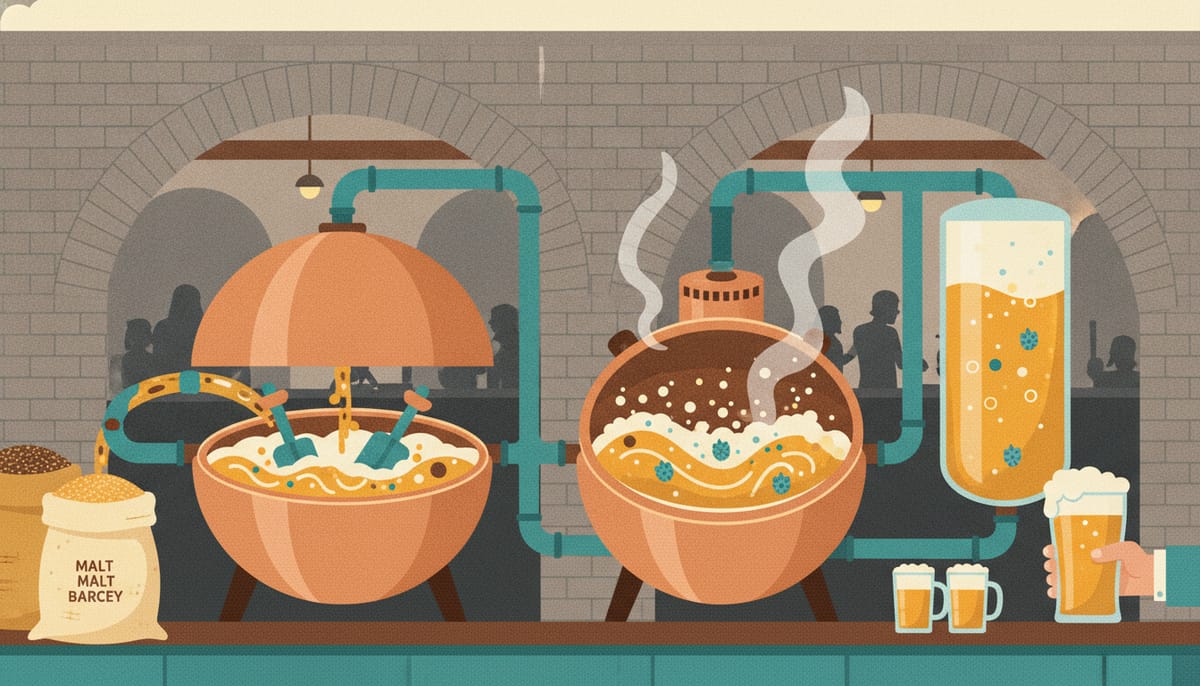
Stand at the bar of any taproom on the Bermondsey Beer Mile and there's a decent chance the beer in your glass was brewed a few metres away, behind the very arch you're standing in. We get asked "so how is this actually made?" on pretty much every tour we run. The honest answer is refreshingly simple once you strip away the jargon: beer comes from just four ingredients and four main stages. Here's how it actually works, from raw grain to the glass in your hand — and what to look out for next time you're stood in front of a working brewhouse.
What is beer made of?
Every beer in the world, from a mass-market lager to the haziest taproom special, starts with the same four core ingredients:
- Malted grain — usually barley, sometimes wheat, oats or rye. Malting is a process that lets the grain partially germinate before it's dried, which unlocks the starches and sugars the brewer needs.
- Water — the biggest ingredient in beer by volume (often 90%+), and its mineral content genuinely affects flavour, which is why certain UK cities became historically famous for certain beer styles.
- Hops — the cone-shaped flowers of the hop plant, added for bitterness, flavour and aroma, and as a natural preservative.
- Yeast — a living organism that eats the sugars in the liquid and converts them into alcohol and carbon dioxide. Without yeast, you simply have sweet, hoppy water; yeast is what actually makes it beer.
Some brewers also add adjuncts — fruit, spices, oats for a softer mouthfeel, or lactose for sweetness — but those four ingredients are the non-negotiable backbone of the process.
Step 1: Malting
Malting usually happens before the grain ever reaches a brewery — most UK brewers, including the independents on the Beer Mile, buy their malt ready-made from a maltster. Raw barley is steeped in water until it starts to germinate, which activates enzymes that will later convert starch into fermentable sugar. The grain is then dried (and sometimes roasted) in a kiln, which stops germination and develops colour and flavour — from pale, biscuity malts through to the dark, roasted malts used in stouts and porters.
Step 2: Mashing
This is where brewing proper begins. The malted grain is milled to crack open the husks, then mixed with hot water (typically around 65-68°C) in a vessel called a mash tun. This warm soak, called mashing, activates the enzymes from malting and converts the grain's starches into fermentable sugars over about an hour. What's left is a thick, sweet, tea-coloured liquid called wort, which is drained off the spent grain — the leftover husks, which many breweries donate to local farms as animal feed rather than sending to waste.
Step 3: Boiling and adding hops
The wort is transferred to a kettle and boiled, usually for about an hour. This does three jobs at once: it sterilises the liquid, it stops any further enzyme activity, and — crucially — it's when hops go in. Hops added early in the boil contribute mostly bitterness, since their bittering compounds need a long boil to fully dissolve. Hops added late, or after the boil in a technique called dry hopping, contribute more aroma and flavour rather than bitterness. This is exactly why two beers using the same hop variety can taste completely different depending on when it was added — one reason a hop-forward IPA can range from sharply bitter to soft and juicy.
Step 4: Fermentation
Once boiled, the wort is rapidly cooled and moved into a fermentation vessel, where yeast is pitched in. This is the step that actually turns sugary liquid into beer: yeast consumes the fermentable sugars and produces alcohol, carbon dioxide and a range of flavour compounds as by-products. The type of yeast and the fermentation temperature is the single biggest factor separating an ale from a lager:
- Ale is fermented warm (roughly 18-22°C) with top-fermenting yeast, usually over about a week, producing fruitier, more characterful flavours.
- Lager is fermented cold (roughly 7-13°C) with bottom-fermenting yeast, then cold-conditioned for weeks afterwards, producing a cleaner, crisper result.
Almost everything you'll taste along the Beer Mile — pale ales, IPAs, stouts, sours — is an ale for exactly this reason: warm fermentation suits smaller-batch, flavour-driven brewing far better than the long cold storage lager needs.
Step 5: Conditioning and maturation
After the main fermentation slows down, the beer needs time to condition — settling out, mellowing any rough edges and, in some styles, developing natural carbonation. A light session beer might condition for just a few days; a strong stout or a barrel-aged beer can take months. This is also the stage where a brewer decides on final carbonation, whether that's naturally in a cask, force-carbonated in a bright tank, or bottle/can-conditioned with a little extra sugar and yeast added at packaging.
Step 6: Packaging
Finally, the beer is packaged — into a keg or cask for the pub and taproom trade, or into cans and bottles for retail. Cask ale is unique in that it's still alive and conditioning in the cask itself, which is why it needs careful cellar management and is best drunk within a few days of being tapped. Keg beer, by contrast, is filtered and force-carbonated before it leaves the brewery, giving a more consistent pour night after night.
What you'll actually see behind a taproom bar
Walk into most of the arches on the Beer Mile and you'll see a scaled-down version of the process above: a mash tun and kettle (sometimes combined into one vessel to save space), a bank of fermentation tanks, and rows of conditioning tanks or kegs. Small independent breweries brew in far smaller batches than the big names — often a few hundred to a couple of thousand litres at a time — which is exactly why the beer changes so often and why regulars keep coming back to see what's new. Our area-by-area guide to London's best breweries is a good next read if you want to know which neighbourhoods are worth exploring beyond Bermondsey.
Why understanding the process changes how you taste
Knowing roughly what happened in the brewhouse genuinely changes how you drink. A hazy, juicy beer probably had a big dry-hop addition after the boil; a sharply bitter one was likely built around an early, long hop boil. A rich, dark stout got its colour and roast character from the malt kiln, not from any additive. Once you know what to look for, tasting stops being guesswork and starts being detective work — which is exactly the approach we take on our guided tours. Our beginner's guide to beer tasting in London is a good companion piece if you want to taste more methodically.
See it for yourself on the Beer Mile
Reading about mash tuns and fermentation is one thing — standing in front of a working brewhouse with a fresh glass in hand is another entirely. Our guided Bermondsey Beer Tasting Tour runs 2–3.5 hours, visits four independent taprooms in the railway arches of South East London, and includes a beer at every stop. A local guide walks you through exactly how each beer was made as you taste it, and you'll get to see real mash tuns and fermenters up close, not just diagrams. We meet at Southwark Brewing Co, 46 Druid St, and we've been running tours since 2014. It's a brilliant day out for groups too — we host private tours for 6 to 60+ people, and gift vouchers are delivered instantly by email and never expire if you know someone who'd love a brewing masterclass with their pint.
A quick brewer's glossary
- Wort: the sweet, unfermented liquid produced by mashing, before yeast is added.
- Mash tun: the vessel where crushed malt and hot water are mixed to extract sugars.
- Spent grain: the leftover husks drained off after mashing, often given away as animal feed.
- Pitching: the moment yeast is added to cooled wort to begin fermentation.
- Dry hopping: adding hops after the boil (often during or after fermentation) purely for aroma and flavour, with no added bitterness.
- Bright tank: a vessel used to clarify and carbonate beer just before it's packaged or kegged.
Ready to see brewing in action?
The fastest way to actually understand how beer is made is to see it happen, glass in hand, with someone explaining each step as you go. That's exactly what a guided afternoon on the Beer Mile delivers — four taprooms, six working brewhouses, and a guide connecting the dots between mash tun and pint glass.