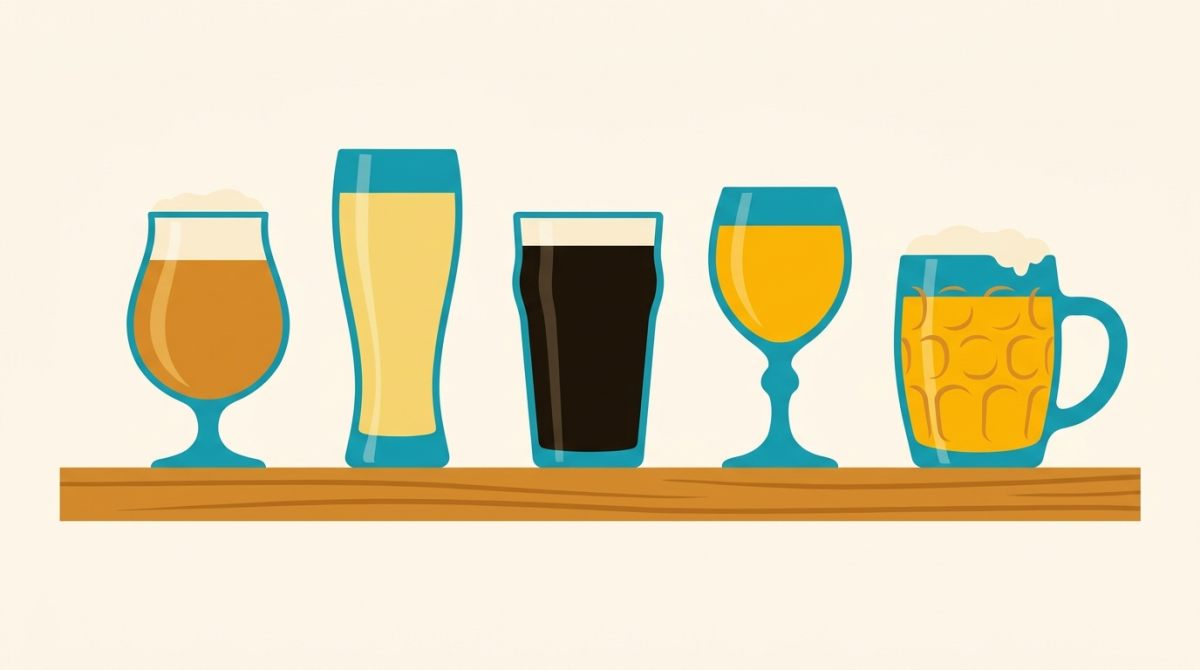
Set six beers down in front of a taproom bar and you'll usually get six different glasses: a straight pint, a curved tulip, a stemmed little snifter, maybe a tall, thin stange for something German. It isn't affectation. On our tastings on the Bermondsey Beer Tasting Tour we watch people notice the aroma of a hazy IPA properly for the first time simply because it's been poured into the right glass — and we've watched the same beer go flat and forgettable in the wrong one. Here's what each shape is actually doing, and which one is worth reaching for at home.
Why does glass shape matter at all?
A glass does three jobs beyond just holding the beer: it directs aroma towards your nose, it shapes and holds the head, and it influences how quickly the beer warms in your hand. None of that changes the beer chemically — a hazy IPA poured into a wine glass is still the same liquid — but it changes what you actually perceive, and perception is most of what tasting is. A narrow opening concentrates volatile aroma compounds where your nose can catch them; a wide one lets them scatter into the room before you get a sniff. A tall, narrow shape holds the beer's temperature longer than a wide, shallow one warmed by more hand contact. None of this is marketing — it's the same logic that gets sommeliers using different wine glasses for reds and whites.
The main glass types, and what they're for
- Pint glass / nonic — the plain conical pint, or its nonic cousin with the small bulge near the rim (added for grip and chip-resistance, nothing more). The honest all-rounder for cask ale, bitter and most lagers, though its wide, straight-sided mouth lets aroma escape quickly.
- Tulip — curves in below the rim before flaring slightly at the lip. That inward curve traps aroma instead of releasing it straight up, which is why most modern craft breweries serve pale ales and IPAs in a tulip rather than a straight glass.
- Teku — a sharper, more angular, stemmed evolution of the tulip, designed jointly by an Italian brewery and glassmaker specifically for serious tasting. The stem keeps your palm off the bowl so you don't warm the beer, and the tight taper concentrates aroma like a good wine glass.
- Stange — a slim, straight-sided cylinder traditionally used for delicate German styles like kölsch. The narrow bowl limits surface area, which keeps a light, easily-oxidised beer fresher and colder for longer.
- Weizen glass — tall, curved and generously sized to make room for the enormous, rocky head a wheat beer throws when poured properly, while still funnelling the banana-and-clove aroma up towards your nose.
- Snifter — short-stemmed with a wide bowl that narrows towards the top, borrowed from brandy service. It's built for strong, boozy, often barrel-aged beers where you want a big surface area to let some heat blow off, plus a narrow top to hold the aroma in.
- Pilsner flute — tall and slender, showing off a pilsner's clarity and fine, persistent bead of carbonation while keeping the aromatic hop character from a good pils from dissipating too fast.
If you want the history behind why lager and pilsner ended up with such different serving cultures to ale in the first place, our guide to lager vs ale covers the yeast and temperature differences that shaped it.
Matching glass to style
As a rough working rule: aromatic, hop-forward beers reward a tulip or teku, delicate pale lagers reward a stange or flute, big strong beers reward a snifter, and everyday session beers are genuinely fine in a plain pint or nonic. Our guide to hazy IPAs goes into why that juicy, aromatic style in particular gets so much out of a properly shaped glass — the aroma really is a huge part of the appeal. A stout or porter sits at the other end: texture and roast character matter more than aroma there, so a simple tulip pint does the job, and our piece on stout vs porter explains why those darker styles developed such a different flavour focus to a hoppy pale ale.
Pilsners and other clean lagers are a style where glass shape genuinely earns its keep too — our deep dive on what is a pilsner explains why a narrow glass suits the style's delicate hop aroma and fine carbonation so well, rather than the wide-mouthed pint glasses lager is often served in by default.
Do taprooms actually bother with the right glassware?
Increasingly, yes — it's one of the small details that separates a good taproom from a generic bar. Most independent breweries we visit on our tastings will reach for a tulip or teku for their hoppy beers and a straight glass for anything session-strength, simply because they've noticed the difference themselves. If you're new to this kind of venue, our explainer on what a taproom actually is covers what else to expect beyond the glassware — from tasting flights to how paying at the bar usually works.
Building your own tasting glassware at home
You don't need a cabinet full of specialist stemware to taste beer properly at home. A single decent tulip glass will do more for an IPA, a Belgian ale or a barleywine than any amount of fancy kit, and a plain tumbler is honestly fine for lager and session beers. If you're planning a proper tasting session with friends, our guide to hosting a beer tasting at home covers glassware alongside pouring order, serving temperature and how to run a simple scoresheet, so you get more out of each beer without overcomplicating the evening.
A note on cask vs keg glassware
Serving format changes the glass conversation too. Cask ale, served at cellar temperature through a hand pump with gentle natural carbonation, is traditionally poured into a plain pint or nonic with barely any head — the beer's softness doesn't need a fancy glass to show it off. Keg beer, served colder and more heavily carbonated, is where you'll see tulips and tekus doing more work, because there's more aroma and a bigger head to manage. Our guide to cask ale vs keg goes into the cellar-temperature and carbonation differences that drive this, if you want the fuller picture.
Cleaning and looking after glassware (the bit nobody mentions)
A genuinely clean glass matters more than an expensive one. Any trace of grease or old detergent residue on the inside of a glass kills head retention almost instantly, which is why a lot of "flat" beer complaints are really a glassware problem, not a brewing one. Rinse glasses with plain water rather than a heavily scented washing-up liquid where you can, and let them air-dry rather than towel-drying, which can leave lint and micro-scratches that beer clings to unevenly.
See it for yourself
The easiest way to notice what a glass actually does is to taste the same style of beer from two different shapes side by side — it's a small experiment that changes how you drink beer generally. On our Bermondsey Beer Tasting Tour (£49pp, 2–3.5 hours, four taprooms, beer included at every stop, meeting at Southwark Brewing Co, 46 Druid Street) our guides pour tasters in whatever glass genuinely suits the beer, and it's one of the small details first-timers tell us they notice most. We also run the Cheese, Meat & Beer Tour (£65pp, Saturdays 12–2:30pm) and the Hackney Wick Craft Beer Experience (£41.25pp, selected Saturdays), and take private groups of 6 up to 60+ on any of them — see private and group tours for details. Gift vouchers are bought directly on our gift vouchers page, delivered instantly by email and never expiring.