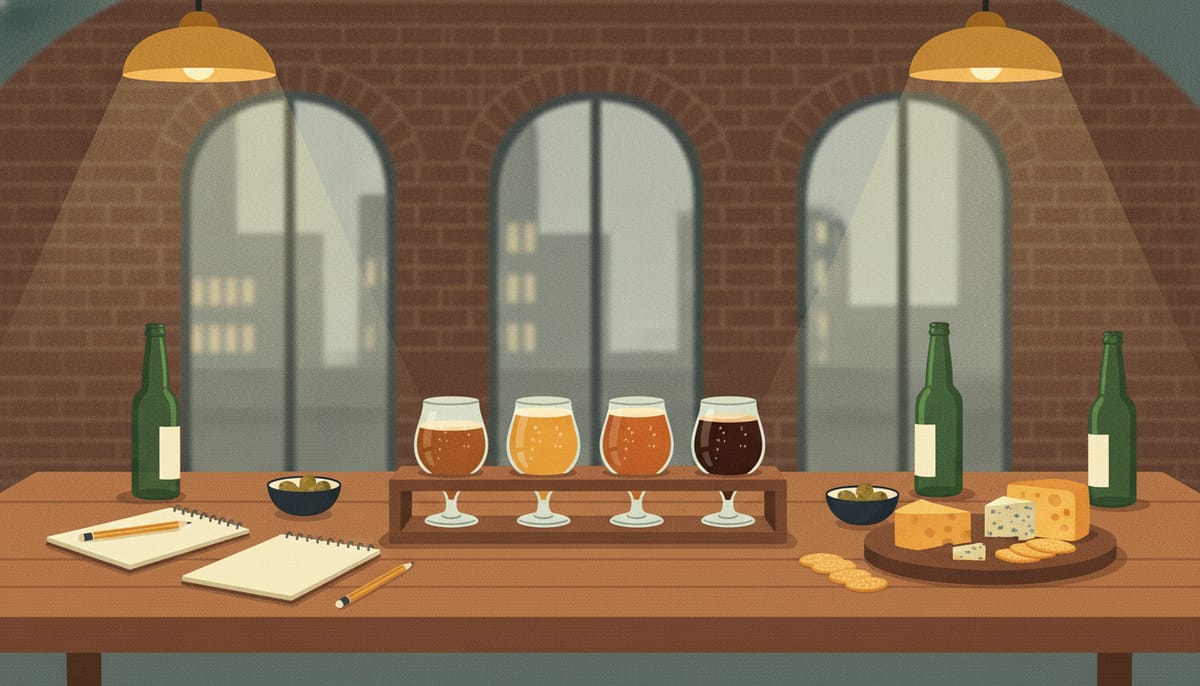
A good beer tasting at home doesn't need much: a handful of interesting bottles or cans, the right glasses, a bit of structure so it doesn't just turn into a normal pint night, and something to nibble on between beers. We run guided tastings on the Bermondsey Beer Mile for a living, so this is the same approach we use with groups every week — scaled down for your kitchen table rather than a railway arch taproom.
What you'll need before you start
Keep the shopping list simple: four to six different beers, one small tasting glass per person (a tulip or wine glass shape rather than a straight pint glass), a jug of water, and something plain to reset the palate between beers — crackers or a bit of bread work better than crisps, which coat your tongue in salt and grease. A notepad or a printed scoresheet (see below) turns idle sipping into an actual tasting, and it's the single easiest way to make the evening feel like more than "beers, but slower."
Choosing your beers (and how many)
Four to six beers is the sweet spot for a casual evening — enough variety to make comparisons interesting, not so many that palates and memories give out by the last one. Aim for genuine contrast rather than six versions of the same thing: a crisp lager, a pale ale, a hoppier IPA, something malty like an amber or brown ale, and a stout or porter to finish gives you real range across styles. If anyone's unsure what separates the styles in the first place, our guide to lager vs ale and our explainer on what IPA actually stands for are both worth a skim before the night, so the conversation has somewhere to go beyond "I like this one."
Glassware: does it really matter?
More than you'd think. A narrower, tulip-shaped glass concentrates aroma at the top of the glass, and smell is most of what you register as flavour — pour the same beer into a straight pint glass and a proper tasting glass side by side and the difference is obvious. You don't need a full set of style-specific glassware to do this properly; one set of simple stemmed glasses per guest, used for every beer, is plenty. One thing that does matter: rinse glasses in hot water only. Washing-up liquid residue kills the head on a beer stone dead, which throws off both the aroma and the presentation.
The right tasting order
Order matters more than people expect. Taste from lightest to darkest and lowest to highest in alcohol, so a big, boozy stout doesn't flatten your palate before you've properly tried the delicate pilsner. A workable running order looks like this:
- 1. Pale lager or pilsner — crisp and light, the easiest starting point.
- 2. Session IPA or golden ale — a touch more hop character, still easy-drinking.
- 3. Full-strength IPA or pale ale — bigger hop aroma and bitterness.
- 4. Amber or brown ale — more malt, caramel and body.
- 5. Stout or porter — roasted, rich, usually the highest ABV of the night.
- 6. (Optional) Barley wine or imperial stout — save anything over 8% for last, and pour a smaller measure.
Pour 100–150ml measures rather than full pints for each round. It sounds stingy, but it means everyone can taste all six beers properly without being either too full or too tipsy to notice anything by the end.
How to actually taste a beer
Slow down and go through it in stages, the same way a guide would talk you through it on one of our tours. Look at the colour and clarity, and how quickly the head fades. Smell before you drink — swirl gently and take a couple of short sniffs rather than one big one, and try to name what you're getting (citrus, biscuit, caramel, coffee). Taste in a proper sip, letting it sit on your tongue rather than swallowing straight away, noting sweetness, bitterness and body. Finish is what lingers after you swallow — dry, bitter, sweet or roasty — and it's often the thing that actually decides whether you liked a beer.
A simple scoresheet you can copy
You don't need anything fancy — a sheet of paper with a few columns per beer works fine. For each beer, jot down: name and style, appearance, aroma (2–3 words), taste, finish, and a score out of 5. At the end, go round the table and compare notes before revealing prices — it's a fun leveller when the £2 supermarket own-label beats something three times the price, which happens more often than you'd expect. Keep the sheets afterwards; they're a genuinely useful record of what your group actually likes, for next time you're choosing gifts or planning a night out.
Beer and cheese pairing basics
Food lifts a tasting from "a few beers" to a proper evening, and cheese is the easiest place to start. As a rough guide: a crisp lager suits mild, salty cheeses like a young cheddar or mozzarella; a hoppy IPA's bitterness cuts beautifully through strong or blue cheese; a Belgian-style or fruity beer pairs well with soft, washed-rind cheeses like a ripe brie; and a stout or porter loves an aged cheddar or something smoked, where the roasted malt echoes the char. You don't need to overthink it — put out four or five cheeses alongside your four or five beers and let people mix and match; half the fun is finding a combination nobody expected to work.
Other food pairings worth trying
Beyond cheese, cured meats (chorizo, salami, a good ham) sit well with malty ambers and brown ales, dark chocolate is a classic match for stout, and something salty and fried — crisps, chips, tempura — nearly always flatters a hoppy IPA. If you want a fuller, more considered set of pairings without doing the legwork yourself, that's exactly what our cheese, meat & beer tasting is built around — a seated, guided version of this same idea, done properly.
Hosting tips for a smooth tasting
- Keep the group to 6–10: big enough for a good conversation, small enough that everyone actually gets to try each beer while it's fresh and cold.
- Serve blind where you can: cover labels or pour in another room — it stops price and branding colouring people's opinions before they've tasted anything.
- Have water and food ready throughout, not just at the start — a scoresheet and six beers over an evening adds up faster than a normal round of drinks.
- Cater for non-drinkers: a good low or no-alcohol option alongside the line-up means nobody's left out of the format, even if they're not drinking the beer itself. Our honest guide to non-alcoholic beer has some solid picks.
- Don't rush the last beer: by the fifth or sixth pour, energy tends to dip — keep pace slow and let the finish sit before moving on.
When you'd rather someone else host it
A home tasting is a brilliant low-cost night in, but there's only so far you can take it without a proper guide, a bigger range of beers on tap, and someone who actually knows the breweries behind each pour. That's where we come in. Our guided Bermondsey Beer Tasting Tour runs for 2–3.5 hours and costs £49 per person with beer included at every stop, taking you through four independent taprooms in the railway arches of South East London — we meet at Southwark Brewing Co, 46 Druid St, and a guide handles the tasting notes so you don't have to. If you liked the idea of pairing food with beer but would rather it was done for you, our cheese, meat & beer tasting is the seated version of exactly this article. Both work brilliantly as private group bookings from 6 up to 60 or more people — see private & group tours if you're planning something bigger than a kitchen table can hold.
Gift a beer tasting experience
If tonight's home tasting goes down well, a proper guided one makes an excellent present for the same crowd. Our gift vouchers are delivered instantly by email and never expire, so the recipient can pick a date that suits their own diary rather than yours. For more inspiration beyond a straight voucher, our roundup of gifts for beer lovers covers tasting flights, glassware sets and brewing kits too.
Good to know
- Buy a couple of spares: if a can is off or a bottle's gone flat, you don't want a gap in the running order.
- Chill correctly, not identically: lighter beers want to be properly cold, but stouts and strong ales show more flavour a few degrees warmer — take darker beers out of the fridge 15–20 minutes before pouring.
- Check units as the evening goes on: six tasting measures add up to less than six pints, but it's still worth keeping an eye on totals — our guide to units in a pint of beer has the maths.
- Keep it social, not a test: scoresheets are there to spark conversation, not to turn the evening into an exam — the "wrong" answer is usually the more interesting one.
Source good cheese and charcuterie
The link below is an affiliate link: if you book through it we may earn a small commission at no extra cost to you. We only suggest experiences we'd recommend anyway.
- Borough Market Food Tour (6 tastings) — a good way to stock up on proper cheese, charcuterie and bread before your own tasting night, guided by someone who knows the stalls.