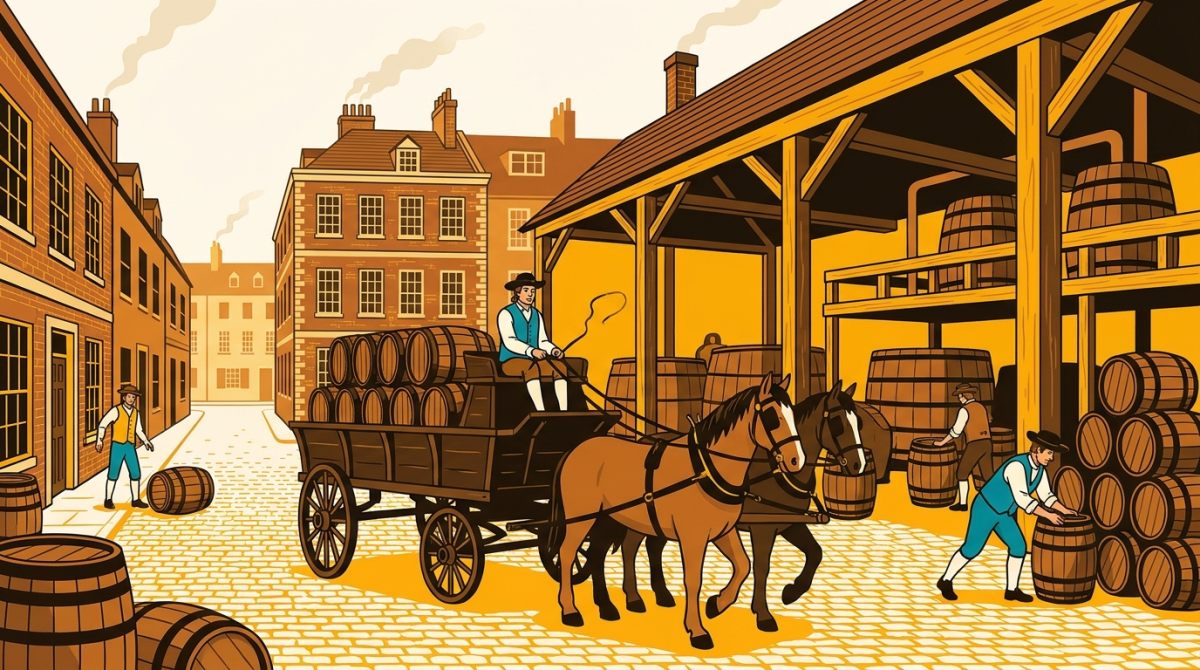
Long before "craft beer" was a phrase anyone used, London had already invented an entire beer style and exported it around the world. Porter is a genuinely London beer - born in the city's alehouses in the early 1700s, brewed on an industrial scale nobody had attempted before, and, for the better part of two centuries, the drink of choice for half the working population of England. Our free, self-guided Southwark heritage walk traces a good chunk of this story on foot, from the site of one of the largest porter breweries in the world to the taproom where our own tours begin, and it's worth knowing the story before you walk it. We've been running tastings through London's independent breweries since 2014, and porter's rise, near-disappearance and recent revival is one of the best stories in British brewing.
Where the name "porter" actually comes from
Porter emerged in London in the early 18th century as a dark, hopped beer brewed from brown malt, and it caught on fast with the city's manual labourers - most famously the street and river porters who carried goods around London's docks, markets and streets, and who are usually credited as the reason for the name. It was strong enough to satisfy, cheap enough for daily drinking, and - crucially for the brewers who made it - stable enough to be brewed in bulk and matured in large volume rather than sold fresh from small casks the way most beer had been before. That combination turned porter from a popular drink into a genuinely industrial product, decades before "industrial" meant much of anything else in Britain.
The brewery that became the biggest in the world
Nowhere illustrates porter's scale better than the old Anchor Brewery on Bankside, founded around 1616 and, under Barclay Perkins in the early 1800s, the largest brewery in the world - built almost entirely on the back of its porter. Dr Samuel Johnson knew the place well through his friendship with the Thrale family who ran it, and when it was sold in 1781 for what was then the enormous sum of £135,000, he's said to have described the business as offering "the potentiality of growing rich beyond the dreams of avarice." The brewery burned down in 1832, was rebuilt, eventually merged into Courage in 1955, and was eventually demolished in 1981. Today only a blue plaque on Park Street marks where it stood, a short walk from The Anchor pub, the riverside survivor where tradition says Samuel Pepys watched the Great Fire of London burn across the water in 1666 - and a stop on our heritage walk, described below.
The scale, and the risk that came with it
Brewing porter at this volume meant building fermentation vats on a scale that would have been unthinkable a century earlier - some holding thousands of barrels at once - and that scale eventually produced one of the strangest industrial disasters in London's history. On 17 October 1814, an iron hoop failed on a 22-foot fermentation vat at Meux & Co's Horse Shoe Brewery on Tottenham Court Road. The vat held roughly 3,500 barrels of porter, and its failure set off a chain reaction among neighbouring vats, unleashing over 320,000 gallons of beer in a single wave. It smashed through the brewery wall and swept into the packed slum housing of nearby St Giles, destroying homes and killing eight people. The London Beer Flood, as it's remembered, is a genuinely sobering footnote to porter's success story - a reminder of just how enormous these Georgian breweries had grown, and how little margin for error came with brewing at that scale. We cover this era in more depth, alongside the rest of London's brewing timeline, in our short history of London beer.
Why porter nearly disappeared
Porter dominated London brewing for the best part of two centuries, but it didn't last forever. Through the 1800s, "stout porter" - a stronger, fuller-bodied version of the standard beer - gradually split off into its own identity as simply "stout", and by the 20th century stout had eclipsed its parent style almost entirely; we've written a full breakdown of exactly how that split happened in our guide to stout vs porter. Porter itself went into steady decline through the 1900s, squeezed by changing tastes, waves of brewery mergers (Watney, Whitbread, Courage among them) and, later in the century, the national shift from cask ale towards keg lager. By the mid-20th century, porter had all but vanished from British pumps - a style that once fuelled an empire's dockworkers reduced to a historical footnote, brewed by almost nobody.
How independent breweries brought it back
Porter's revival is really the story of British craft beer's revival more broadly. From the mid-2000s, a new generation of small independent breweries started digging back into historic recipe books, and porter - along with stout, its old rival - was an obvious style to resurrect: full of flavour, relatively cheap to brew, and steeped in genuine local history. The Kernel, founded in a Bermondsey railway arch in 2009 and among the most influential of this new wave, was known early on for exactly this kind of historically-minded brewing, and porter has been a regular fixture on London taproom boards ever since. It's a beer you'll now find rotating through the independent breweries along the Bermondsey Beer Mile as often as any pale ale or IPA - proof that the style never really deserved to disappear in the first place.
Walk the route yourself
If you'd rather see this history than just read about it, our free Southwark heritage walk is a self-guided route of about a mile and a half, taking roughly two hours, that starts at Borough Market and passes the old Anchor Brewery site on Park Street - porter's old industrial heartland - before finishing at Southwark Brewing Co on Druid Street, right at the head of the Bermondsey Beer Mile and exactly where our guided tastings begin. There's no ticket and no booking required; it's simply the best way we know to connect porter's Georgian story to the independent breweries writing its next chapter today.
Tasting porter today
Reading about porter only gets you so far - the beer itself is the point. On our Bermondsey Beer Tasting Tour (£49 per person, 2-3.5 hours, beer included across four independent taprooms, meeting at Southwark Brewing Co, 46 Druid St), porter and its darker relatives turn up regularly alongside the pale ales and IPAs, and our guides are always happy to point a table towards one if history is what you're after that afternoon. If you'd rather pair the beer with food, our Cheese, Meat & Beer Tour runs Saturdays from 12-2:30pm and often works a dark, malty beer like porter into its pairings alongside sharper, hoppier styles - our guide to lager vs ale is a useful primer if you want to understand where porter sits relative to the paler styles most people know better before you go.
A history worth bringing a group to
Porter's story - dockworkers, industrial giants, a genuine beer flood and a craft-driven comeback - tends to land well with a group, whether that's a work social looking for something more interesting than the usual pub, or a milestone birthday that wants a bit of substance behind the drinking. We run private groups from 6 up to 60 or more people across all three of our tours, and if a history-minded beer day is a gift rather than something you're booking for yourself, our gift vouchers are bought directly on that page, delivered by email instantly, and never expire, so whoever receives one can pick their own date to walk this story for themselves.
Porter is, in a real sense, London's original export beer - a style the city invented, scaled up beyond anything brewed before it, nearly lost entirely, and has since helped bring back to life. Whether you walk the heritage route, taste a modern version on a tour, or just remember the name next time you see one on a taproom board, it's a piece of London history that's still very much drinkable today.