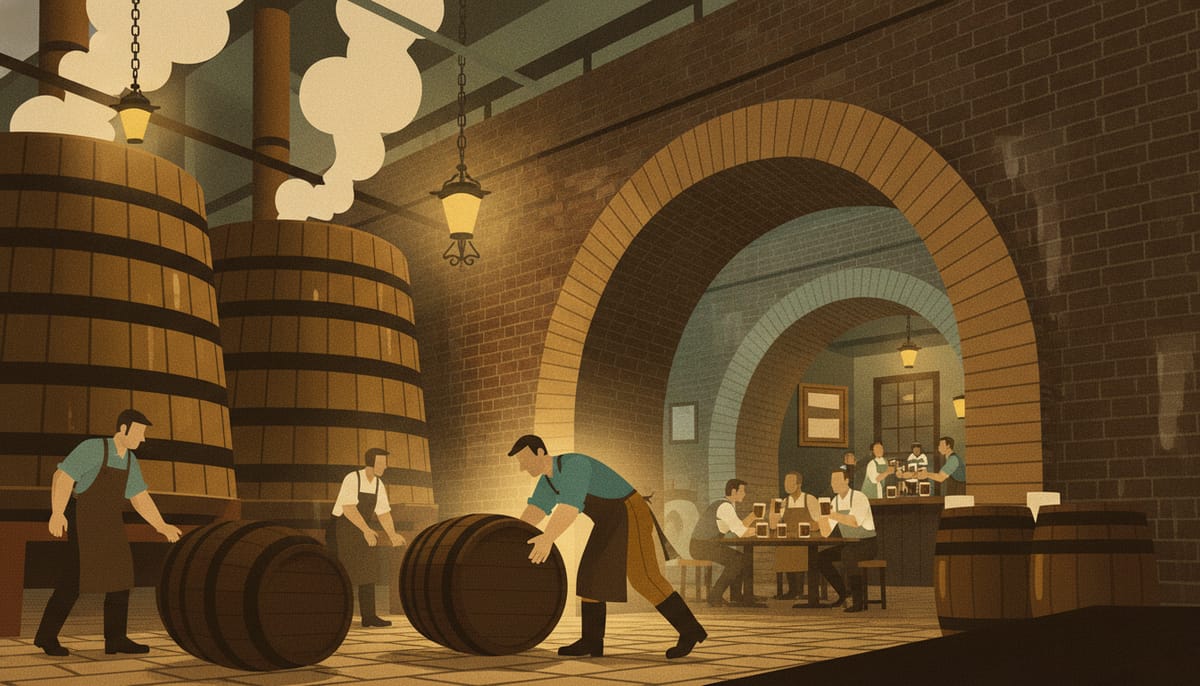
London has been a brewing city for close to two thousand years, and it's the reason a guided beer tour through South East London makes any sense at all. Long before "craft beer" was a phrase anyone used, this city built and lost the largest breweries on Earth, invented an entire beer style, survived a genuinely bizarre industrial disaster, and then quietly rebuilt its brewing scene from almost nothing. We've been running tours through Southwark's arches since 2014, and the history underneath our feet is a big part of why we do it. Here's the short version.
Roman roots and the medieval alehouse
Brewing on the site of London goes back to at least Roman times, when ale was a routine part of the diet rather than a treat — safer to drink than much of the water, and brewed at a fairly low strength by modern standards. That habit carried through the Saxon and medieval periods, when ale was an unhopped, quick-fermenting drink brewed by the barrelful in thousands of small London households and alehouses. By the 14th century, London's brewers were organised enough to form their own livery company, the Worshipful Company of Brewers, regulating quality, weights and prices across the city — an early sign of just how central beer already was to London life.
Hops arrive, and "ale" becomes "beer"
Hops reached England from the Low Countries in the 15th century, and their arrival split London's drinkers for a while — traditionalists stuck with unhopped ale, while a newer, hop-bittered drink calling itself "beer" slowly won out because it kept better and travelled further. By the 17th century the distinction had mostly disappeared and "beer" covered both, brewed on an increasingly commercial scale by dedicated London brewhouses rather than in the back room of every house and pub.
Porter: London's beer, brewed at industrial scale
The 18th century is where London's brewing story turns genuinely global. Around the 1720s, London brewers developed a dark, well-hopped, roasty beer that became known as porter — reputedly popular with the city's hard-working street and river porters, who gave the style its name. Porter was the first beer style brewed at real industrial scale: it aged well in huge vats, so breweries could brew enormous batches and store them for months, which suited London's size and its thirst perfectly. Breweries like Whitbread, Truman, Barclay Perkins and Courage grew into some of the largest manufacturing operations in the world on the back of porter and its stronger cousin, stout, with single London breweries eventually producing well over a million barrels a year. For a while, London wasn't just a brewing city — it was the brewing capital of the planet.
The London Beer Flood of 1814
That scale came with real risk, and nowhere illustrates it better than the London Beer Flood. On 17 October 1814, an iron hoop failed on a 22-foot fermentation vat at Meux & Co's Horse Shoe Brewery on Tottenham Court Road. The vat held roughly 3,500 barrels of porter, and its failure triggered a chain reaction among neighbouring vats, releasing over 320,000 gallons of beer in a single wave. It smashed through the brewery wall and swept into the packed slum housing of nearby St Giles, destroying homes and killing eight people. It remains one of the strangest and most tragic industrial accidents in London's history — a genuine flood of beer through a Georgian back street — and a sober reminder of how enormous these Victorian and Georgian breweries had become.
The Victorian peak
Through the 19th century, London's breweries kept growing. Whitbread's Chiswell Street site, Truman's vast Brick Lane brewery in Spitalfields and Barclay Perkins in Southwark became landmarks in their own right, employing thousands and shipping porter and stout as far as the Baltic and the Caribbean. Brewing clustered particularly around Southwark and Bermondsey, where good water, river access for shipping grain and beer, and railway arches for cheap storage made the area a natural home for maltings, hop merchants and breweries — the same railway arches that, over a century later, would house a very different kind of brewery.
Decline: mergers, keg lager and closure
London's brewing dominance didn't survive the 20th century intact. Two world wars, rationing and rising costs squeezed smaller brewers first, and from the 1950s onwards a wave of mergers consolidated London's brewing names into a handful of large groups — Watney Combe Reid, Courage, Whitbread — that gradually shifted production away from traditional cask ale towards mass-market keg lager, brewed more cheaply and often outside London altogether. Property pressure did the rest: brewery sites in Zone 1 and 2 became worth vastly more as offices and flats than as breweries. Truman's historic Brick Lane brewery closed in 1989 after more than three centuries on the site, and by the 1990s London — the city that once brewed more beer than anywhere on Earth — had only a small handful of breweries left standing.
The craft revival, and the return to Bermondsey
The recovery started quietly in the mid-2000s and then took off fast. A new generation of small, independent brewers began setting up in cheap industrial units around the city, chasing flavour and variety rather than scale. The Kernel, founded in a Bermondsey railway arch in 2009, was among the first and most influential — brewing hop-forward pale ales and reviving historic London porter and stout recipes in the very streets that had supplied the city's beer a century earlier. Other breweries followed into the neighbouring arches, and what started as a handful of taproom doors propped open on a Saturday grew into the modern Bermondsey Beer Mile — now one of the densest stretches of independent breweries anywhere in the world. You can read the fuller story of that particular chapter in our history of the Bermondsey Beer Mile. London now has well over a hundred independent breweries across the city, a scene we round up area by area in our guide to London's best breweries.
What actually survives from all that history
Surprisingly little of the physical fabric of London's great Victorian breweries survives as breweries today — most of the big sites are now flats, offices or, in Truman's case, a market and events space. What has survived is the geography: Southwark and Bermondsey are still where London's independent brewing is concentrated, the same rough patch of ground that housed maltings and brewhouses for well over a century. A good number of London's oldest pubs also survive nearby, from Southwark's coaching inns to the riverside taverns of Wapping and Rotherhithe — we cover those in our guide to historic London pubs, which pairs naturally with this one if you want the drinking history and the brewing history side by side.
Is modern craft beer really a "revival"?
It's a fair question, and the honest answer is: partly. Modern London breweries owe more to American craft beer's hop-forward influence than to Georgian porter recipes, and the scale is nowhere near what Truman's or Whitbread once achieved. But the underlying story — small, independent operators brewing distinctive beer in Southwark's arches, sold on quality rather than cheapness — is closer to London's brewing roots than the mass-market keg lager era ever was. If you want to understand where "craft beer" actually sits in that story, our guide to what is craft beer unpacks the definition in more detail.
See the history in person
The best way to understand all this is on foot. Our free self-guided heritage walk traces Southwark's brewing and drinking history through the streets and arches that once supplied beer to half of London, finishing near where our afternoon tours begin. Follow it with our Bermondsey Beer Tasting Tour (£49pp, 2–3.5 hours, tastings included at four independent taprooms, meeting at Southwark Brewing Co, 46 Druid St) and you've walked the entire arc of London brewing in a single day — from the same ground that built porter's empire to the independent breweries writing its next chapter. We run private groups from 6 to 60+, so it works well for a milestone birthday, a work day out or just a group of friends who like their history with a pint in hand.
Gift the history
History buffs and beer lovers make an easy gift list overlap. Our gift vouchers cover the heritage walk and the Beer Mile tour, are delivered instantly by email, and never expire, so whoever you're buying for can pick their own date.