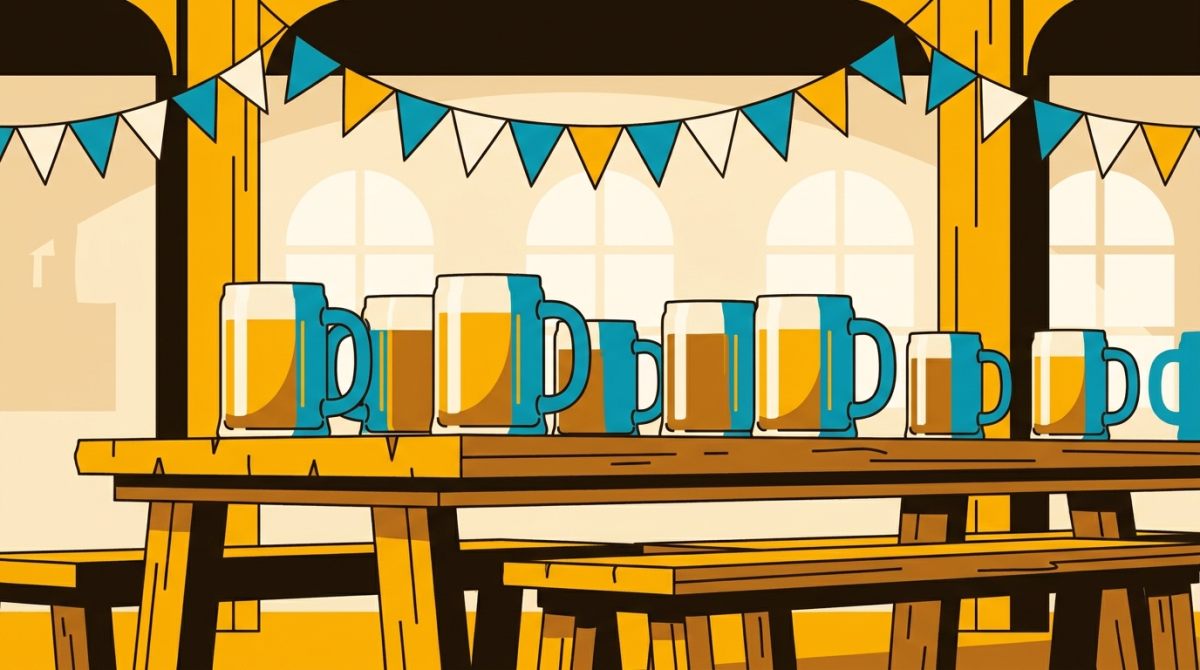
Autumn means Oktoberfest events popping up across London, from our own roundup of where to celebrate to full Bavarian beer halls going all-in on steins and oompah bands. But ask most people what's actually in the glass and you'll get a shrug. "Oktoberfest beer" isn't one fixed recipe — it's really two related lager styles with a genuinely interesting bit of brewing history behind the switch from one to the other. We've been guiding tutored tastings on the Bermondsey Beer Mile since 2014, so here's the honest style guide: what Märzen and Festbier actually are, why Munich's own festival doesn't pour what you'd expect any more, and what to order this year.
Where the tradition started
The original Oktoberfest wasn't a beer festival at all — it began in Munich in 1810 as a horse race and public celebration for the wedding of Crown Prince Ludwig (later King Ludwig I of Bavaria) and Princess Therese. The fields where the celebrations were held are still called the Theresienwiese, or "Wiesn" for short, which is why Bavarians often still call the modern festival "the Wiesn" rather than Oktoberfest. Beer stalls and tents grew up around the event over the following decades and gradually became the main attraction, and by the late 19th century the beer itself — a stronger, autumn-appropriate lager — had become as central to the festival as anything else on the fairground.
What actually is "Oktoberfest beer"?
"Oktoberfest beer" is a loose umbrella term rather than a single legally protected style. It generally means one of two related German lagers: Märzen, the historic autumn style, or Festbier (sometimes called Wiesn beer), the lighter, paler lager that Munich's big festival breweries actually serve today. Both are bottom-fermented lagers rather than ales — brewed with lager yeast at cold temperatures and left to condition for weeks, which is what gives them their clean, malt-driven character rather than the fruitier notes you'd get from a warm-fermented ale. If you want the fuller story on why that yeast and temperature split matters across all beer styles, our guide to lager vs ale covers the basics.
Märzen: the traditional Oktoberfest lager
Märzen takes its name from März, German for March — the month it was traditionally brewed, before refrigeration made summer brewing reliable. Brewers made a stronger, more heavily hopped batch in March, then stored ("lagered") it through the warm months in cool cellars or Alpine ice caves, ready to drink once the weather turned in autumn. That's the direct ancestor of the modern Oktoberfest tradition — using up the last of the previous brewing season's beer at the festival.
Classic Märzen is amber to copper in colour, with a firm, bready, toasty malt backbone from Vienna and Munich malts, restrained hop bitterness, and a smooth, clean lager finish. ABV typically sits around 5.8-6% — noticeably stronger than an everyday lager, but built for a long, unhurried drinking session rather than a quick pint.
Festbier: what's actually in your stein at Munich's Oktoberfest today
Here's the twist most people don't know: the beer served inside the official tents at Munich's own Oktoberfest hasn't really been traditional Märzen for decades. From around the 1970s onward, the big Munich breweries that supply the festival gradually shifted to Festbier — a paler, golden, more sessionable lager, generally similar in strength (roughly 5.8-6.3% ABV) but lighter-bodied and easier to drink by the litre stein (a Mass) over a long afternoon than a heavier, darker Märzen. Festbier keeps a solid malt sweetness but drops much of Märzen's toasty depth in favour of drinkability at volume — which makes sense once you picture several hours of table-thumping and singing.
Märzen didn't disappear; it's simply become more of an autumn seasonal style brewed and sold outside the festival tents, including by breweries well beyond Munich, rather than the beer actually poured at the source event.
Both styles pair well with the food you'd expect on the same table: roast pork, pretzels, sausages and sauerkraut all sit comfortably alongside a malt-forward lager without either the food or the beer fighting for attention — which is a large part of why the pairing has stuck for two centuries.
Served in a stein: does the glass matter here too?
Traditionally, yes — Oktoberfest beer is served in a one-litre glass stein (a Mass), not a dainty tasting glass, and that's deliberate. A stein's thick glass and wide handle are built for holding a full litre steadily through a long session, not for concentrating aroma the way a tulip or teku does. If glassware and how much it changes a beer's character interests you generally, our guide to beer glass types covers why a hoppy craft beer benefits from an entirely different shape to a festival lager — the stein is really about volume and grip, while a tasting glass is about aroma.
Märzen vs Festbier at a glance
- Colour: Märzen is amber/copper; Festbier is pale gold.
- Body: Märzen is fuller and toastier; Festbier is lighter and more sessionable.
- ABV: both typically 5.8-6.3%, similar strength despite the different body.
- Where you'll meet it: Festbier is what's actually poured inside Munich's festival tents today; Märzen is the older style now mostly found as an autumn seasonal release.
What UK Oktoberfest events actually pour
Recipes and branding vary a lot from one UK event to the next, and not every venue is precise about which style they're serving — "Oktoberfest beer" on a UK festival menu might mean an imported German Festbier, a locally brewed Märzen-inspired lager, or simply a stronger house lager rebadged for the season. If you're planning an evening around one, our roundup of Oktoberfest events across London is a good starting point, and for our own corner of the city, the Bermondsey Bierkeller's Oktoberfest runs a full autumn programme of steins, oompah bands and Bavarian food a short walk from the railway arches where we run our tastings. Always check the specific venue's own site for the current beer list and prices — festival line-ups shift from year to year.
What to order if a full-strength stein isn't for you
You don't have to commit to a litre of 6% lager to join in. Most Oktoberfest-style events also stock a lighter helles alongside the festival beer, and non-alcoholic or low-alcohol options are increasingly common too — worth asking at the bar rather than assuming your only choice is the festival special. If you do go for the full stein, pace yourself: our guide to units in a pint of beer is a useful reality check on how quickly a stronger lager adds up compared with a standard pint.
Where to taste real German-style lagers in London
Beyond the dedicated Oktoberfest events, a handful of London breweries turn out proper Festbier or Märzen-style seasonals through September and October, alongside their regular lager range — ask what's on when you're out, since these tend to be limited, taproom-only releases rather than beers you'll find bottled everywhere. If clean, well-made lager is your thing generally, our explainer on what is a pilsner covers the other end of the German and Czech lager family, and pairs nicely with a Märzen if you want to taste the two side by side.
Bring the Oktoberfest spirit to a beer tour instead
If you'd rather skip the crowds and taste your way through independent London brewing than queue for a stein, that's exactly what we do on the Beer Mile. Our Bermondsey Beer Tasting Tour (£49pp, 2-3.5 hours, four taprooms, beer included at every stop, meeting at Southwark Brewing Co, 46 Druid Street) is a small-group, guided tasting through railway-arch breweries a few feet from the tanks — not a Bavarian import, but a proper autumn afternoon of good beer all the same. We also run the Cheese, Meat & Beer Tour (£65pp, Saturdays 12-2:30pm) and the Hackney Wick Craft Beer Experience (£41.25pp, selected Saturdays), and take private groups of 6 up to 60+ on any of them — perfect for an office autumn social. See private and group tours for details, or gift the whole thing: vouchers are bought directly on our gift vouchers page, delivered instantly by email and never expiring.