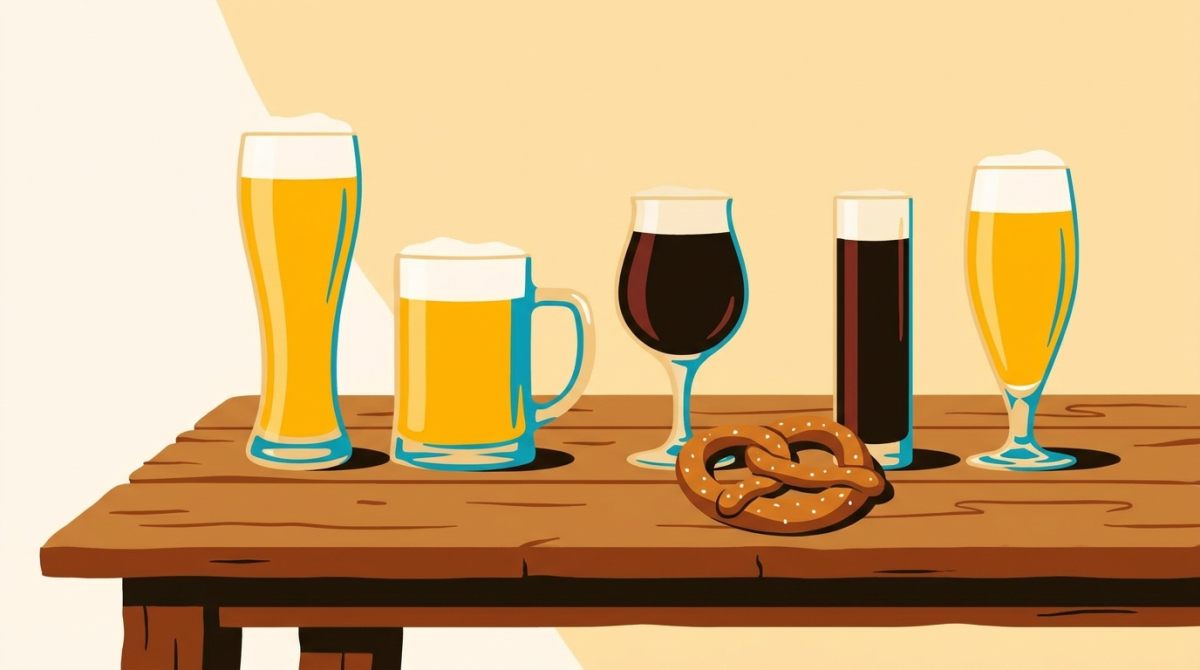
"German beer" gets talked about as if it's one thing, and it really isn't. Germany has one of the most rigidly regional brewing cultures in the world - a beer that's the everyday pint in Munich barely exists thirty miles away, and Cologne guards its own style so fiercely that ordering the wrong glass in the wrong bar will get you gently corrected by the bar staff. With Oktoberfest season bringing German-style beer into UK pubs and events every autumn, we get asked a lot at our tastings what people are actually drinking when they order a "German lager". This is our honest, no-jargon guide to the main styles, what they actually taste like, and what to eat alongside them. If you want the full picture on what's poured at UK Oktoberfest events specifically, we've covered that separately in our guide to Oktoberfest beers.
Why Germany has so many distinct beer styles
Two things shaped German beer more than anything else: the 1516 Reinheitsgebot, which restricted brewing ingredients to water, barley and hops (yeast wasn't understood yet, and was added to the law later), and centuries of brewing being organised city by city rather than nationally. Munich, Cologne, Bamberg and Berlin each developed their own house styles largely in isolation, and those regional identities have stuck hard - Germans are often fiercely loyal to their local style in a way that's less common in UK drinking culture. The result is a country where "beer" doesn't mean one thing at all, and where the style on the label tells you almost as much about where it's from as what's in the glass.
Helles: Munich's everyday lager
Helles ("pale" or "bright") is what most Münchners actually drink day to day - a soft, malt-forward pale lager at around 4.5-5.5% ABV, with just enough hop bitterness to keep it balanced rather than to make a statement. It's less assertively hopped than a typical pilsner and rounder in the mouth, built to be drunk in quantity over a long afternoon rather than sipped and analysed. If you've had a "German-style lager" in a UK pub that felt clean, malty and easy-going rather than sharply bitter, there's a decent chance it was brewed in the helles tradition, whether or not the label says so.
Dunkel: the original Munich style
Before helles became dominant in the 19th century, dunkel ("dark") was Munich's standard beer. It uses the same clean lager yeast and gentle hopping as helles, but with darker malts that bring toasted bread, light caramel and a touch of chocolate to the flavour, without tipping into the roasty bitterness you'd get from a stout. It's still widely brewed and, we'd argue, underrated outside Bavaria - a genuinely food-friendly style that pairs particularly well with roasted meat.
Weissbier (Hefeweizen): the wheat beer everyone's had
Weissbier, or hefeweizen, is probably the German style most UK drinkers already know, even if only from supermarket shelves. Brewed with a large proportion of wheat alongside barley malt, and fermented with a distinctive yeast strain, it produces the banana-and-clove aromatic signature that defines the style, along with a naturally cloudy appearance from the suspended yeast. Bavarian weissbier is the classic version; a dunkelweizen swaps in darker malt for a maltier, slightly spiced take on the same base.
Kölsch: Cologne's own rules
Kölsch is a genuinely odd one, and a good example of why the neat lager-versus-ale split people learn isn't always so tidy - we go into that distinction properly in our lager vs ale guide. It's brewed with ale yeast at relatively warm, ale-like fermentation temperatures, then cold-conditioned afterwards the way a lager would be, giving it a clean, crisp, almost lager-like character despite technically being an ale. It's only allowed to be called Kölsch if it's brewed within Cologne itself, under a legally protected designation, and it's traditionally served in small, slender 200ml glasses called Stangen, refilled continuously by the waiter until you put a beer mat on top of your glass to signal you're done.
Bock, Doppelbock and Eisbock: the strong ones
Bock is a stronger, maltier lager style, typically 6.5-7.5% ABV, historically brewed for winter and festival occasions. Doppelbock ("double bock") pushes further, often 7-10% ABV, with deep malt sweetness and a warming finish - many doppelbock names traditionally end in "-ator" as a nod to the original, Salvator. Eisbock takes things further still by partially freezing the beer and removing the ice, concentrating the remaining liquid into something closer to 9-14% ABV. These are sipping beers rather than session styles, and worth treating with the same respect you'd give a strong barleywine.
Rauchbier and Berliner Weisse: the regional outliers
A couple of styles are worth knowing even though you'll rarely stumble across them outside specialist bottle shops. Rauchbier, most closely associated with Bamberg, is brewed using malt dried over an open flame, giving the finished beer a genuine smokiness - divisive, but fascinating with the right food. Berliner Weisse is a low-ABV, tart wheat beer historically served with a shot of fruit syrup to soften its sharpness; it's a close cousin, stylistically, to the sour styles we've covered before in our guide to sour beer, and a useful reference point if you're already into that end of the flavour spectrum.
Pilsner: Germany's most-copied export
Pilsner didn't originate in Germany - it was first brewed in Plzeň, in what's now the Czech Republic, in 1842 - but German brewers adopted and refined it so thoroughly that it's now the single most-produced beer style in the country, and arguably the world. German pilsner tends to be drier and more crisply bitter than helles, with a more pronounced hop character, though still restrained compared with a modern craft IPA. Because it's such a broad and important topic on its own, we've given it a full write-up in our dedicated pilsner guide, which is worth reading if this is the style you actually drink most often.
What you'll actually find at a UK Oktoberfest event
Here's where it gets genuinely confusing for a lot of people. Historically, Oktoberfest in Munich served märzen, an amber, malt-forward lager brewed in March and lagered through summer for the autumn festival. Modern Munich Oktoberfest beer, sometimes labelled Wiesnbier, has actually drifted closer to a strong pale helles over the last few decades. UK Oktoberfest events, meanwhile, vary enormously in what's actually on tap - some import genuine German festival beer, others pour a UK-brewed lager badged for the occasion, and it's genuinely worth checking the specific event rather than assuming. We've written a full breakdown of what you're likely to find, and how to tell the difference, in our Oktoberfest beers guide.
Pairing German beer styles with food
As a rough rule of thumb: helles and pilsner are the flexible, food-friendly all-rounders, equally happy alongside a pretzel, sausages or a simple salty snack. Dunkel and bock lean into roasted or grilled meat and hard, nutty cheeses, where the malt sweetness plays well against savoury, charred flavours. Weissbier's citrus and banana notes make it a good match for lighter charcuterie, seafood or anything with a squeeze of lemon in it, and rauchbier's smokiness is made for cured or barbecued meat. If pairing beer and food deliberately sounds like your kind of afternoon, it's exactly the logic behind our own Cheese, Meat & Beer Tour (£65pp, Saturdays 12-2.30pm) - four independent Bermondsey taprooms, each matched with cheese and cured meat chosen to work with what's in the glass, even though the beers themselves are British rather than German.
Trying these styles for yourself
A handful of London bottle shops and specialist beer pubs stock genuine German imports, and it's worth seeking one out if you want to taste helles, kölsch or a proper bock without travelling. Seasonal Oktoberfest events each autumn are the easiest way to try festival-style beer without leaving the city, though as above, it's worth checking what a specific event is actually pouring before you commit an evening to it. If you'd rather explore beer styles closer to home, our tours focus on independent London brewing rather than German imports, but the same principles - clean lagers versus malt-forward darker styles, food-matching, tasting side by side - apply just as well to what's coming out of the Bermondsey railway arches. Groups of 6 up to 60 or more can book privately through our private and group tours page, and if you know a German-beer obsessive who'd enjoy a London equivalent, our gift vouchers are bought directly on that page, delivered instantly by email, and never expire.
The honest summary: "German beer" is really a family of quite different regional styles, each shaped by centuries of local brewing tradition - helles and pilsner for easy, everyday drinking, dunkel and bock for something maltier and stronger, weissbier for the fruity wheat-beer character most people already recognise, and kölsch as the fascinating exception that shows the lager-ale divide isn't always so clean. Understanding the difference makes ordering - whether in Munich, at a UK Oktoberfest event, or from a specialist bottle shop - a lot less of a guessing game.