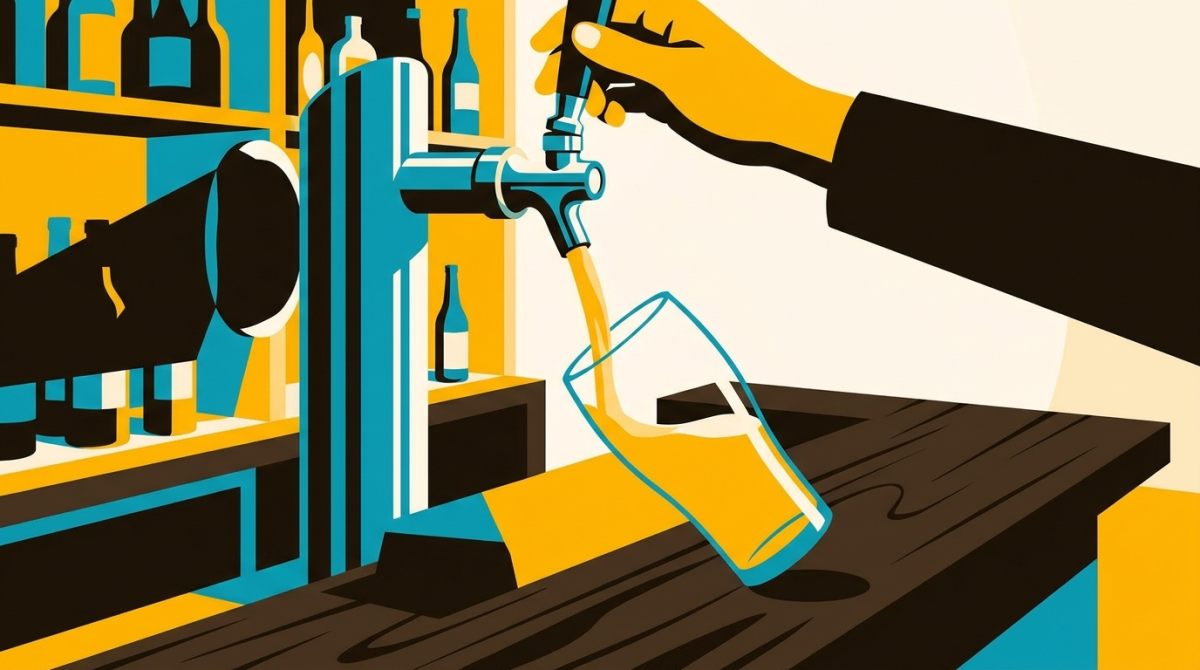
Ask ten people what makes a "good pour" and most will say something about the head — too much, too little, or exactly right. There's real technique behind it, and it isn't the same technique for every beer. Cask ale, keg lager and Guinness are all poured differently, on purpose, because they're carbonated differently and served through different equipment. We pour six or seven different beers a day on our tastings across the Bermondsey Beer Mile, so this is the version of the explanation we actually give people standing at the bar, not the pub-quiz trivia version.
Why the pour actually matters
A pour isn't just presentation. The head on a beer traps aroma compounds and slows the release of carbon dioxide, which is why a beer with no head at all tends to taste flatter and less aromatic within a couple of minutes, even if nothing else about it has changed. Pour too hard and you knock out too much carbonation and get an overly foamy, thin-tasting pint; pour too gently and you can end up with a flat, undercarbonated one that hasn't had a chance to release its aroma at all. The angle of the glass, the distance from the tap, and how steady your hand is all change that balance, which is why the same beer can taste noticeably different depending on who pulls it.
Pouring cask ale properly
Cask ale is the odd one out, because it isn't pushed out by gas pressure at all — it's served by gravity or hand pull, using the residual carbonation that built up naturally during a secondary fermentation in the cask itself. That means cask beer is naturally lower in carbonation than keg beer, and a good pour reflects that: one steady pull down the side of a clean, wet glass, starting tilted and gradually straightening as the glass fills, aiming for a thin, loose head rather than a tight foamy one. If your cask pint looks fairly flat with light, lacy foam clinging to the glass, that's not a bad pour — that's what cask ale is supposed to look like. We cover the wider differences between the two serving methods, including temperature and mouthfeel, in our guide to cask ale vs keg beer, which is worth reading alongside this if you're new to real ale.
Pouring keg beer with a proper head
Keg beer is forced out under gas pressure, which makes it more consistently carbonated but also easier to over-pour into a foamy mess if you're not paying attention. The standard technique is to tilt the glass to roughly 45 degrees under the tap and pour steadily down the inside wall until it's around two-thirds full, then straighten the glass upright and finish pouring through the middle of the beer rather than down the side. That last stage is what actually builds the head — aim for somewhere around two to three centimetres, enough to hold aroma and look right without eating a third of your pint in foam. It sounds fussy written out, but it's really just two movements: tilt and pour, then straighten and finish.
The two-part Guinness pour, properly explained
Guinness gets its own section because it genuinely is poured differently, and there's a real reason for it rather than pure theatre. Guinness uses a nitrogen and carbon dioxide gas blend rather than carbon dioxide alone, which produces much finer, smaller bubbles than a typical lager. Pouring it in one go would create a violent surge of those bubbles that needs time to settle, so the traditional two-part pour exists specifically to manage that: pour the first part at a 45-degree angle to about three-quarters full, let it stand for a minute or two while the surge settles and the cascade effect works its way up the glass, then top it up with a slower, straight pour through the middle to finish with a tight, creamy head sitting just proud of the rim. If you want the fuller story on how the beer itself is made rather than just how it's poured, our guide to the Guinness Open Gate Brewery in London covers the visitor side of things, including how the brewery talks about its own pour.
Glass shape: does it actually change the beer?
The beer inside is identical whichever glass it goes in, but the glass genuinely changes how you experience it. A narrower glass, or one that tapers inward near the top, concentrates aroma compounds towards your nose as you drink, which suits a hoppy pale ale or IPA where the aroma is a big part of the appeal. A wider, more open glass lets a stronger or more complex beer breathe and warm up slightly, which suits a big stout or barleywine better than a narrow flute would. It's part of why a well-run taproom keeps more than one glass shape behind the bar rather than pouring everything into the same generic pint glass — the shape is doing real work, not just looking nice on a shelf.
Why a taproom pour can look different from a pub pour
If you've noticed that a beer poured at a taproom sometimes looks a little different from the same style at a chain pub, there's usually a practical reason rather than anything mysterious. A taproom is typically pouring straight from a cold room a few metres from the tap, often through shorter, better-maintained lines, so temperature and carbonation tend to be more consistent than at the end of a longer supply chain. Taprooms also tend to pour deliberately to the style — a hazy IPA is poured for a soft, rocky head while a stout is poured for a dense, long-lasting one — rather than pouring every beer the same way regardless of what it is. Our guide to what a taproom actually is goes into more of that behind-the-bar detail if you're curious about what separates a taproom from an ordinary pub.
Common pouring mistakes worth knowing
- Pouring straight down the middle from the start: this creates too much turbulence too early and knocks out carbonation, leaving you with an overly foamy pour that then goes flat.
- Using a warm or dirty glass: residue or grease on a glass wall (even from washing-up liquid that hasn't fully rinsed) will kill the head almost instantly, no matter how good the pour is.
- Treating every beer the same: a cask bitter, a hazy IPA and a Guinness are not aiming for the same head size or pour speed, and pouring them identically usually means at least one comes out wrong.
- Rushing the Guinness settle: topping up too soon before the surge has settled is the single most common reason a Guinness pour looks messy rather than layered.
- Ignoring the angle change: staying tilted for the whole pour, or straightening too early, is usually why a keg pour ends up either flat or mostly foam.
Where to actually watch it done well
Reading about pouring technique only gets you so far — it's the kind of thing that clicks once you've watched someone do it properly a few times and can ask why. On our Bermondsey Beer Tasting Tour you'll see beer poured fresh at four independent taprooms across the Bermondsey railway arches, £49 per person for 2-3.5 hours with beer included at every stop, starting at Southwark Brewing Co, 46 Druid St. If you'd rather build your own tasting knowledge at home first, our guide to hosting a beer tasting at home covers glassware, pouring order and a simple scoresheet approach that works well for a small group.
Bringing a group, or gifting the experience
If a few of you are into this level of beer detail, we run private tastings for groups of 6 up to 60+ across all three of our tours — the Bermondsey Beer Tasting Tour, the Cheese, Meat & Beer Tour, and the Hackney Wick Craft Beer Experience — see our private and group tours page for details. Gift vouchers are bought directly on our gift vouchers page, delivered instantly by email and never expiring, which makes a fairly reliable gift for anyone who'd rather learn to pour a proper pint than unwrap another mug.
Fancy trying the world's most famous pour, done properly?
The link below is an affiliate link: if you book through it we may earn a small commission at no extra cost to you. We only suggest experiences we'd recommend anyway.
- Guinness Storehouse self-guided tour with a free pint — includes a pint poured for you at the rooftop Gravity Bar in Dublin, a good add-on if a trip to Ireland is on the cards.