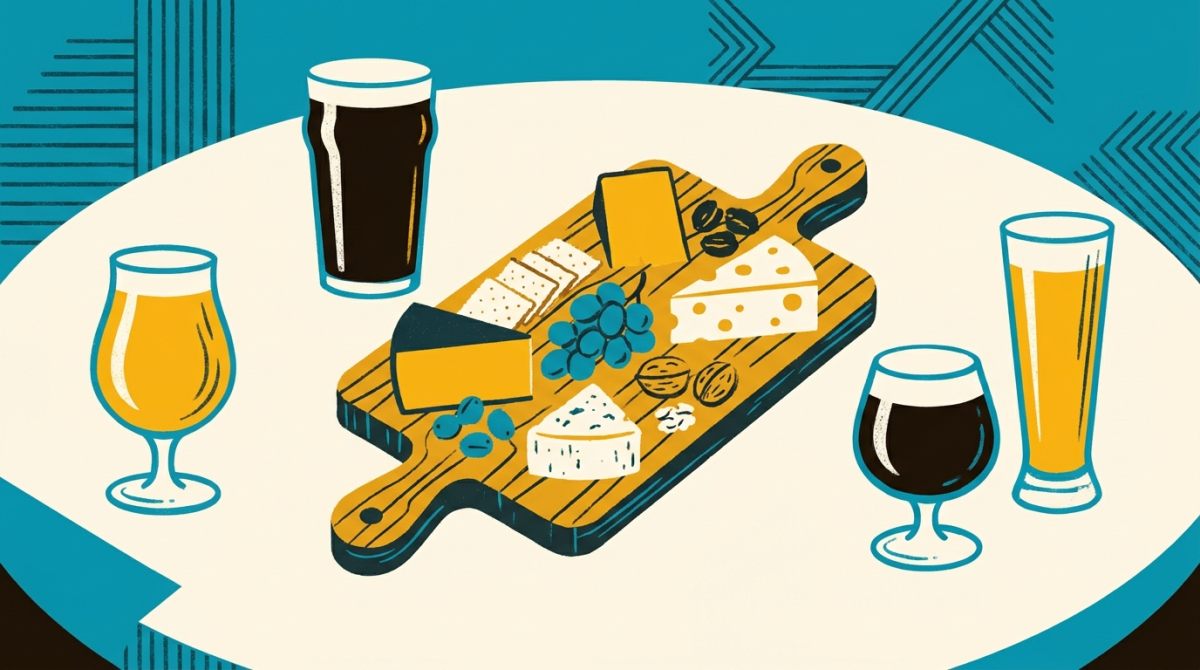
Wine gets the reputation, but beer is the better match for cheese, and it's not close once you understand why. Carbonation and bitterness do things to fat and salt that still wine simply can't, and beer's range of sweetness, roast and strength gives you a far wider set of tools to match against any given cheese. We build a whole guided tour in Bermondsey around exactly this idea, but you don't need to book anything to start getting it right at your own kitchen table - here's the logic, the classic matches, and how to run a proper tasting at home.
Why beer beats wine with cheese
The case against wine isn't that it's bad with cheese - it's that tannin, wine's main structural tool, actively fights with milk fat. Tannin binds to protein and fat and can turn chalky or metallic against a rich cheese, which is why a lot of "wine and cheese night" pairings are actually fighting each other rather than working together. Beer doesn't have this problem in the same way. Carbonation physically scrubs fat off the palate between bites, resetting your tongue for the next one, and hop bitterness does a version of the same job that tannin attempts, cutting richness cleanly instead of clashing with it. On top of that, beer covers a genuinely huge stylistic range - crisp and dry, sweet and roasted, sour and funky, big and boozy - so there's almost always a beer style that mirrors or contrasts a specific cheese in a way a fixed grape variety can't match as precisely.
The pairing logic, in plain terms
Most good pairings work on one of two principles: matching intensity, or contrasting flavour. Matching intensity means a delicate young cheese (a fresh chèvre, a mild Brie) gets a lighter beer - a pilsner, a wheat beer, a session pale - so neither one drowns the other out. A pungent, aged or blue cheese needs something with enough weight to stand up to it: a barleywine, an imperial stout, an aged sour. Contrasting flavour is the other lever - sweetness against saltiness (a fruit-forward beer with a salty blue), roast against sweetness (a stout with something caramelised), or bitterness against fat (an IPA with a full-fat, oily cheese). Once you're thinking in those terms rather than trying to memorise a list of "correct" pairings, you can improvise with whatever's actually in your fridge.
Classic matches to start with
A handful of pairings are close to foolproof and worth knowing by heart. A hoppy pale ale or IPA next to a mature cheddar is the easiest win in the whole exercise - citrusy hop bitterness cuts the cheddar's fat and salt cleanly, and both halves are cheap and easy to find on a Tuesday. A rich stout or porter against a strong blue cheese plays roasted sweetness off sharp saltiness, and the beer's body matches the cheese's intensity almost perfectly. A crisp, dry pilsner or lager alongside a young, mild cheese - a soft goat's cheese or a mild Gouda - keeps things light and refreshing rather than heavy. And a Belgian-style tripel or a barleywine next to a hard, nutty, aged cheese (an aged Gouda or a Comté-style hard cheese) matches two big, complex flavours against each other rather than one overpowering the other.
Building your own pairing board
Four to six pairings is the sweet spot for a home tasting - enough to feel like a proper exploration without everyone losing track of which beer went with which cheese by pairing three. Pour small measures, roughly a third of a pint each, and cut cheese into small, uniform pieces so tasters can go back for a second bite without filling up on the first one. Work roughly from lightest to heaviest, both in the beer and the cheese, so your palate isn't blown out by a big imperial stout before you've tried the delicate pilsner-and-chèvre pairing. Taste the cheese alone first, then the beer alone, then together, and give people a minute of quiet before moving on - it sounds fussy, but it's the difference between a tasting and just eating cheese while drinking beer in the same room. If you want a structured way to record what worked, our guide to hosting a beer tasting at home covers glassware, tasting order and a simple scoresheet approach that works just as well once cheese is on the table.
Beyond cheese: the wider pairing picture
Cheese is the headline pairing, but the same logic - matching intensity, contrasting flavour, using carbonation and bitterness as tools rather than obstacles - applies to food generally. Our beer and food pairing guide covers the broader rules by style (IPA with spice, stout with chocolate, sour with cutting through richer dishes) if cheese has got you curious about doing the same thing with a full meal. It's worth reading if tonight's tasting board turns into a habit, because the underlying principles carry straight across from a cheese plate to a proper dinner.
Where charcuterie fits in
Cured meat sits alongside cheese in almost the same pairing logic - fat, salt and often smoke, all things carbonation and bitterness handle well. Salami and other cured meats generally want a beer with enough bitterness or acidity to cut the fat, in much the same way a mature cheddar does, while smoked or peppered meats can take a bigger, maltier beer without being overwhelmed. If you're building a home tasting board, a mix of cheese and cured meat against the same run of beers gives you more pairing combinations to work through without needing to buy anything exotic.
Doing it properly with a guide, not a printout
Reading about pairing logic only gets you so far - tasting six deliberately chosen combinations back to back, with someone explaining why each one works as you go, is a different experience entirely. Our Cheese, Meat & Beer Tour (£65pp, Saturdays, 12pm–2:30pm) is exactly that: a small-group walk between independent Bermondsey taprooms tasting proper cheese, cured meat and craft beer together, with a guide talking through the pairing logic at each stop rather than leaving you to guess. It runs alongside our Bermondsey Beer Tasting Tour (£49pp, 2–3.5 hours, beer included across four independent taprooms, meeting at Southwark Brewing Co, 46 Druid St) if you'd rather skip the food and focus purely on the beer. Both work for private groups from six people up to 60 or more via private and group tours, and we've been running them since 2014.
Buy a taster's gift, not another bottle
The link below is an affiliate link: if you book through it we may earn a small commission at no extra cost to you. We only suggest experiences we'd recommend anyway.
- Borough Market Food Tour with 6 Authentic Tastings — a guided way to explore cheese and other produce close to Bermondsey if you want a food-first tasting before or after a beer afternoon.
Our honest take
Beer and cheese pairing isn't a gimmick or a wine-alternative for people who can't afford the "real" thing - carbonation and bitterness genuinely do a better job with fat and salt than tannin does, and beer's stylistic range gives you more precise matches to work with. Start with the foolproof pairings (IPA and cheddar, stout and blue cheese), build up to four or six pairings on a proper board, and taste each cheese and beer alone before trying them together. If it turns into something you'd rather do guided, with someone else doing the buying and the talking, a gift voucher for our Cheese, Meat & Beer Tour, bought directly on our gift vouchers page, delivered by email instantly and never expiring, is a genuinely good present for anyone who'd rather taste something new than unwrap another bottle.